
Executive summary
October producer prices rose 0.3% on the month, under the 0.4% consensus reported by CNBC, and stocks opened higher. The gains did not last. SPY closed down 0.36% at $754.37 and QQQ down 1.20% at $679.89, its first close below its 200-day average since Tuesday. The 12-month producer-price rate was 6.5%, the largest since November 2022 according to the Bureau of Labor Statistics, and outlets reported the 10-year Treasury yield near 5.15% at the close.
The losses were concentrated in technology, and within it in AI hardware. AMD fell 8.75%, Dell 7.18% and Coherent 6.00%, three names CNBC grouped under broad AI-linked selling, and Broadcom fell 4.76% on the day Rothschild & Co Redburn cut it to Neutral, an analyst opinion. Nvidia lost 2.01% to $162.85 on the day HSBC analyst Frank Lee cut it to Hold with a $170 target, an analyst opinion. Most other stocks rose: 315 of 503 S&P 500 members advanced, the median stock gained 0.34%, and eight of eleven sectors had more gainers than losers. For the week SPY rose 2.59% and QQQ 3.63%.
After the close QQQ's final after-hours trade was $674.25, 0.83% below its close. SPY's after-hours quote was unavailable. All 27 AI 30 names with a fresh quote were lower, and Nvidia's last trade was $161.01. Next week brings retail sales on Tuesday morning, Nvidia's results after Tuesday's close, the Fed's minutes on Wednesday, and Anthropic's IPO, reported by CNBC to be scheduled to price Wednesday, November 18. Our view for Monday and Tuesday is neutral at the index level, a step back from Thursday's modestly bullish lean: 60% of our weight sits on the bull and base cases, and the bear trigger is a QQQ close below $671.68 or a SPY close below $745.20, Friday's lows. We stay constructive on the broad S&P 500 and cautious on concentrated AI.
Since the close
Times are Eastern. Prices are final after-hours trades against Friday's regular close. The after-hours session ended at 8:00 p.m., and the quotes were collected at 5:04 a.m. Central on Saturday, November 14. The after-close news sweep was not run tonight. Index futures were not pulled, so QQQ's after-hours trade is the only index read we have, and SPY's after-hours quote was unavailable.
- The funds. QQQ's last after-hours trade was $674.25, down 0.83%, after a high of $680.01 and a low of $673.46. SPY: unavailable. The 20 largest stocks by market value, weighted by market value as a proxy for index weights, were down 0.74%. Apple slipped 0.24%, Microsoft 0.27% and Meta 0.73%.
- Producer prices and rates. We have no after-hours yield reading. The long-Treasury fund TLT last traded at $79.42, up 0.05%. Fed Vice Chair Philip Jefferson was scheduled to speak at 7:00 p.m.; his remarks were not captured.
- Nvidia after the HSBC downgrade. NVDA's last after-hours trade was $161.01, down 1.13%, with a low of $160.35. House Foreign Affairs Chair Brian Mast and Representatives John Moolenaar and Rick Crawford had set an 8:00 p.m. deadline for former Nvidia CEO Jensen Huang and Nvidia general counsel Tim Teter to answer a request for a December 1 closed-door interview, as CNBC and NBC reported. No response had been reported by about 6:40 p.m., and we have nothing later.
- AI hardware. The regular-session decline continued. AMD's last trade was $521.20, down 2.41%. Marvell fell 2.66%, Micron 2.20%, Broadcom 1.99% and Dell 1.57%. Nebius lost 2.66% and CoreWeave 2.60%. The chip funds SMH and SOXX were down 1.07% and 1.77%. Of the AI 30, 27 had a fresh quote and all 27 were lower, for a median of −1.28%; Synopsys, Snowflake and Salesforce were unavailable. Cerebras, outside the dashboard's lists, was down 2.50% at $106.00. We have no reported cause for the after-hours moves.
- About 4:00 p.m. onward — FAA ground stop, as reported. The FAA halted departing flights nationwide around 4:00 p.m., citing a temporary telecommunications outage at its air-route control centers (CNBC). By about 6:00 p.m. the agency said departures would resume as facilities recovered; a full lift was not confirmed in the reports we hold. After hours JetBlue fell 2.92%, Delta 2.45%, United 1.93%, American 1.75%, Alaska 1.30% and Southwest 1.27%.
- 4:11 p.m. — Fox 8-K. Fox said it closed $8.4 billion of senior notes on Friday and repaid the bridge loan used to help fund its November 6 purchase of Roku (company filing). After-hours quotes for both Fox share classes were unavailable.
- 4:05 to 5:12 p.m. — debt filings. Qualcomm sold $4.0 billion of notes, Booking Holdings €3.55 billion, American Tower $1.5 billion, a TKO subsidiary $1.0 billion of secured notes and Apollo $600 million of junior notes (company filings). Qualcomm was down 0.91% after hours and Booking 0.61%; American Tower, TKO and Apollo were unavailable.
- 4:01 to 4:41 p.m. — officer filings. Moderna said Chief Legal Officer Shannon Thyme Klinger will retire by March 31, 2027 (company filing). Moderna was down 2.40% after hours.
- The week-ahead calendar is a list of dates and carries no price reaction.
- Tie to the Outlook. QQQ's $674.25 is $5.58 below $679.83, the bear line in Thursday's outlook, which is judged on closes through Tuesday. It is $2.57 above Friday's low, the bear line in the new scenarios below. Nvidia's $161.01 is $4.81 above the $156.20 it needs to hold. So no after-hours price sits beyond a new trigger, and one sits beyond Thursday's.
Section by section
Pulse: why did SPY fall when most of its stocks rose?
SPY: −0.36%, 62.6% of 503 members advancing (315 up, 185 down, 3 unchanged), 66.9% / 71.6% / 63.6% above the 20-, 50- and 200-day averages. QQQ: −1.20%, 43.6% advancing (44 of 101), 50.5% / 54.5% / 54.5%. AI 30: 5 of 30 up, 20.0% / 23.3% / 43.3%. Crypto-related equities: 1 of 7 up.
SPY's average stock gained 0.13% and its median stock 0.34%. A fund that falls while its average and median members rise is being pulled down by its largest weights. That is the reverse of Thursday, when SPY lost about the same amount while its median stock fell 0.76% and 124 members rose. QQQ's −1.20% compares with −0.76% for its average stock and −0.44% for its median, so there too the largest names lost more than the rest. Which names did the most is a view, since contributions are unavailable; AMD, Broadcom and Nvidia, three large technology weights, all fell.


The session: a higher open that faded
SPY opened at $760.07, 0.39% above Thursday's close, and that was nearly its high of $760.12. It fell to $745.20 and closed at $754.37, 61.5% of the way up its range. QQQ opened at $688.54, touched $688.75, fell to $671.68 and closed at $679.89, about the middle of its range.
Two levels from Thursday's outlook matter here. QQQ's 200-day average is now $682.24, and the close was $2.35 below it. The bear line set on Thursday, $679.83, held at the close by six cents after QQQ traded more than eight points under it during the day. SPY closed 70 cents above Thursday's low of $753.67 and $12.42 above $741.95.
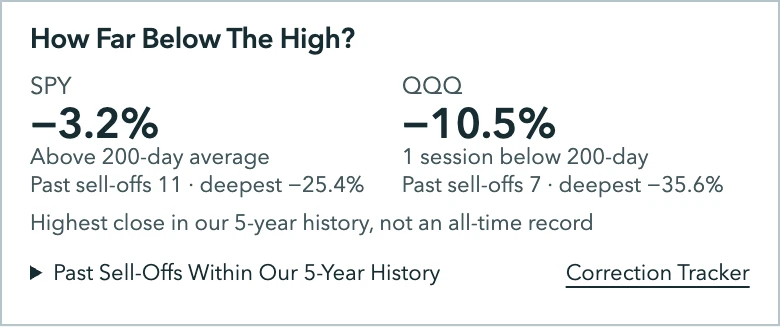
How deep is the correction?
SPY closed 3.17% below its October 6 closing high of $779.09, from 2.82% on Thursday. QQQ closed 10.50% below $759.66, from 9.41%, which puts it back past 10%. That is the current distance. The deepest point of QQQ's decline remains the 14.82% reached on November 5. SPY is 3.07% above its 200-day average and QQQ 0.34% below; the panel marks Friday as QQQ's first session under that average in the current count.
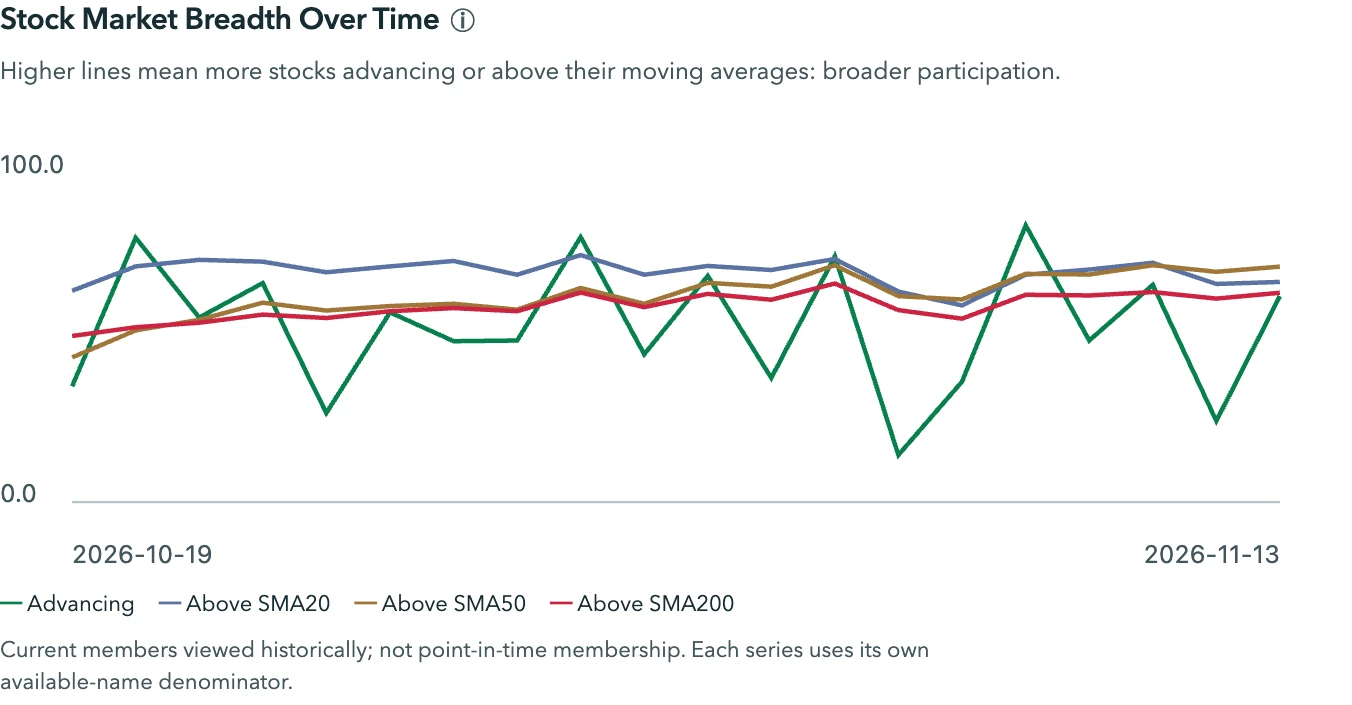
Breadth over time: the long-trend share rose
The share of S&P members above their 200-day average rose to 63.6% (315 of 495) from 61.8% on Thursday. It has stayed between 61.8% and 63.8% all five sessions this week, against the 55% line we have watched. There were 8 new 52-week highs, among them Apple, Costco, Johnson & Johnson, Coca-Cola and Procter & Gamble, against one new low, Coinbase. The Nasdaq-100 had two new highs and one new low, and 54.5% of its members are above their 200-day average. S&P member dispersion was 1.68 percentage points, the 16th percentile of the past year, which fits a day when most stocks moved by similar, small amounts and the large moves sat in one group.
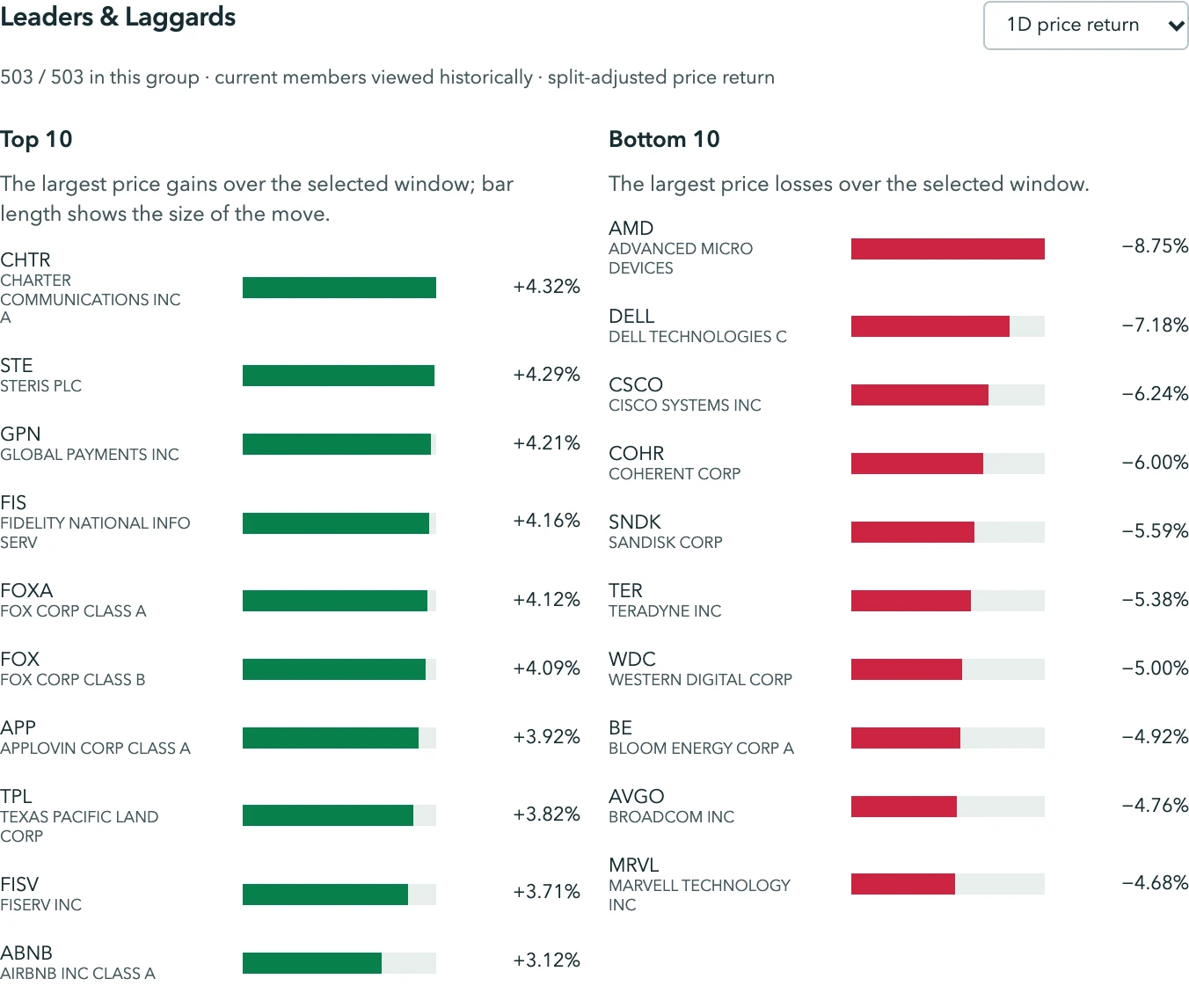
Leaders and laggards: nine of the S&P's ten largest losers were technology stocks
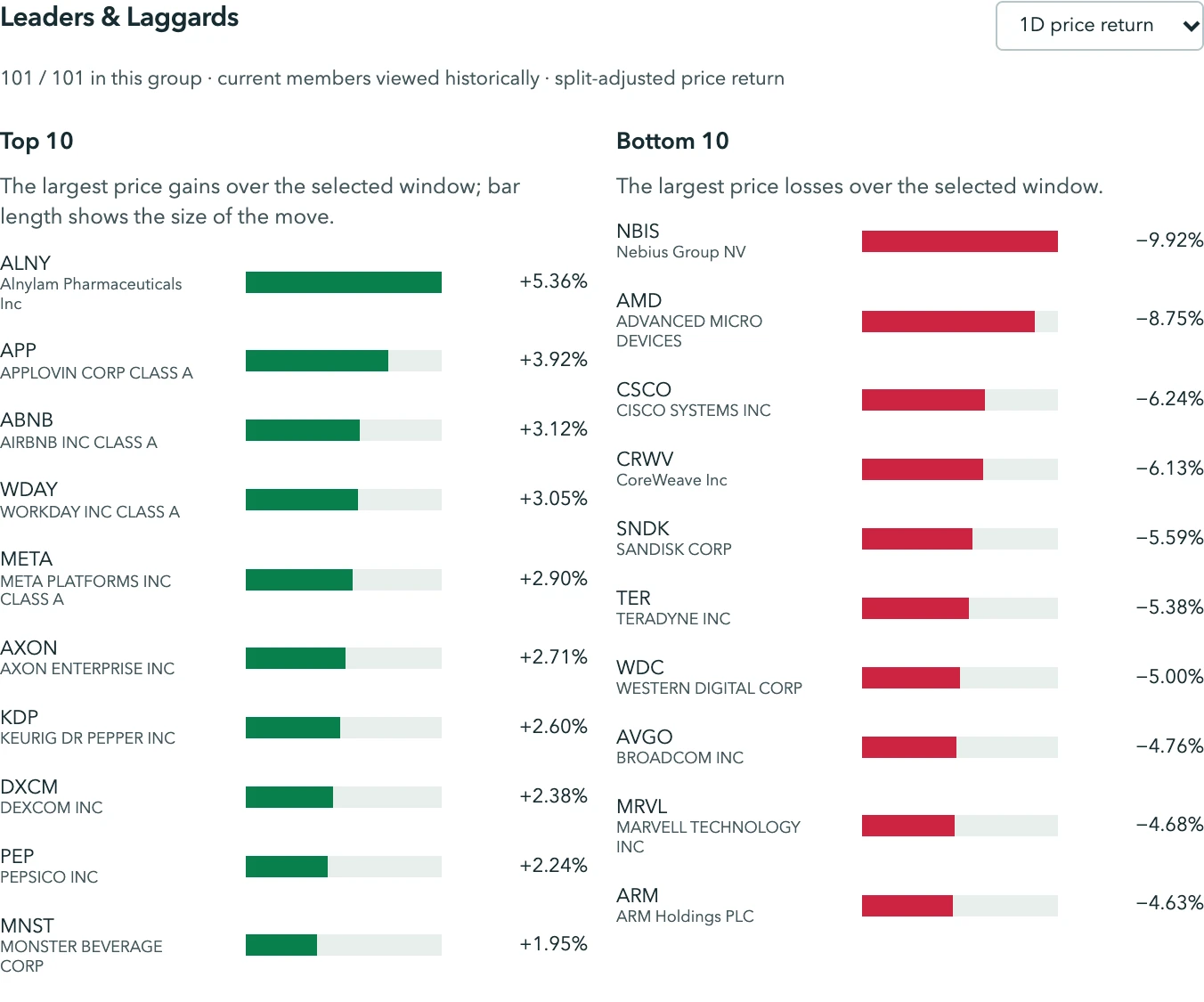
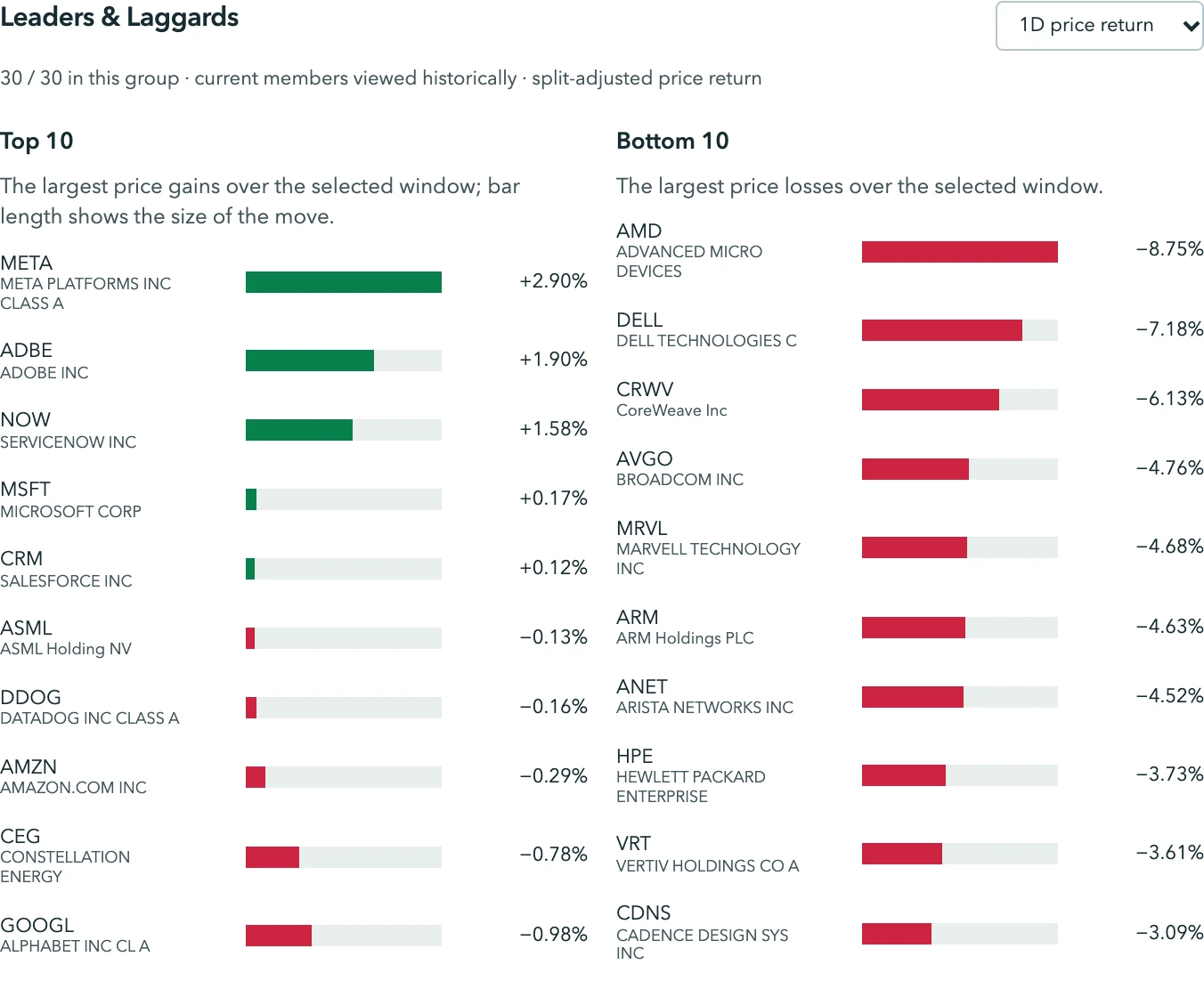
S&P leaders: Charter +4.32%, Steris +4.29%, Global Payments +4.21%, Fidelity National Information Services +4.16%, Fox Class A +4.12%. Laggards: AMD −8.75%, Dell −7.18%, Cisco −6.24%, Coherent −6.00%, Sandisk −5.59%. Of the ten largest S&P losers, nine are in Technology and the tenth is Bloom Energy. In the Nasdaq-100, Alnylam (+5.36%) led, and Nebius (−9.92%) was weakest, followed by AMD, Cisco and CoreWeave (−6.13%). In the AI 30 the only five gainers were Meta +2.90%, Adobe +1.90%, ServiceNow +1.58%, Microsoft +0.17% and Salesforce +0.12%; AMD, Dell, CoreWeave, Broadcom and Marvell (−4.68%) trailed.
The news around these moves, as reported and not as established causes. AMD had no company news; trading-news outlets reported it giving back part of the gain it made after Jensen Huang's exit. Rothschild & Co Redburn cut Broadcom to Neutral, questioning whether AI labs can finance themselves (analyst opinion). Cisco fell the day after its results, and coverage pointed to product-order growth slowing to 21% from 35%. Trading-news outlets reported the Nebius and CoreWeave declines as tied to fears that Nvidia could reduce its support for such companies under Nvidia interim CEO Colette Kress. That coverage cited a Reuters report, itself citing people familiar, that Kress and her finance staff had clashed with Huang over large financing packages; Nvidia has not confirmed it. Jefferies upgraded Steris (analyst opinion). No Friday report was found for Charter, Global Payments or Fidelity National Information Services.
AI 30: the count slipped back to seven
Seven of the 30 AI names are above their 50-day average, from 8 on Thursday, and 13 are above their 200-day, from 14. The median AI stock fell 1.78% on the day and is up 5.06% over five sessions. The average AI stock is 30.3% below its own 52-week high, from 28.8%; that is an average of distances, not a basket return. Nvidia is the group's one oversold name, with an RSI of 24.9. AMD, Broadcom and Arista, the S&P's three leaders in Thursday's entry, fell 8.75%, 4.76% and 4.52%. We gave three reasons for raising the bull case on Thursday evening: Nvidia's filing, in which the resignation was accepted, an interim CEO named and the results date kept; the session's gains in AMD and Broadcom; and a firm after-hours tape. One session took most or all of the second back.

What about Nvidia?
Nvidia opened at $169.91, traded between $170.00 and $158.39, and closed at $162.85, down 2.01%. CNBC reported it up about 2% at the open before it turned lower after the HSBC note. HSBC analyst Frank Lee cut the stock to Hold and lowered his target to $170 from $365, saying uncertainty will persist until a permanent succession plan is set; that is his opinion. Outlets reported the company's market value ending below $4 trillion. The stock is down 12.75% over five sessions, has an RSI of 24.9 and is below both its 50-day and 200-day averages.
Against the levels named on Thursday: $168.89, the level to reclaim, was crossed during the day but not at the close, which was $6.04 under it, and $156.20, the level to hold, held. In Washington, NBC reported that Commerce Secretary Howard Lutnick agreed to appear before the Senate Banking Committee, where Chair Tim Scott proposed a December 10 hearing. The underlying claims about chip shipments remain allegations. Results are still scheduled for Tuesday, November 17, after the close.
Held up in the sell-off
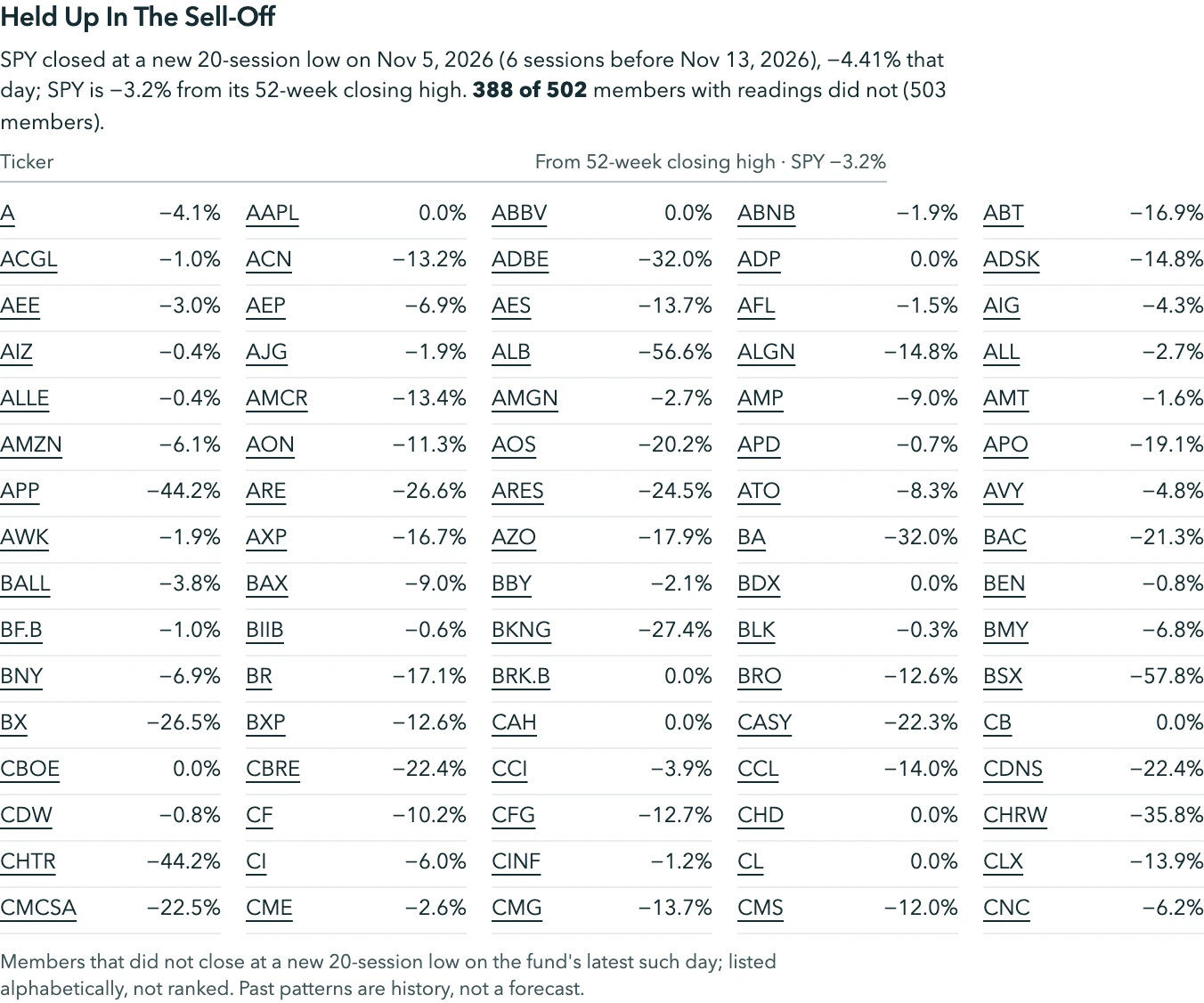
The anchor is unchanged and now 6 sessions back: 388 of 502 S&P members with readings and 59 of 101 Nasdaq-100 members did not close at a new 20-session low on November 5.
Sectors: eight of eleven had a majority advancing
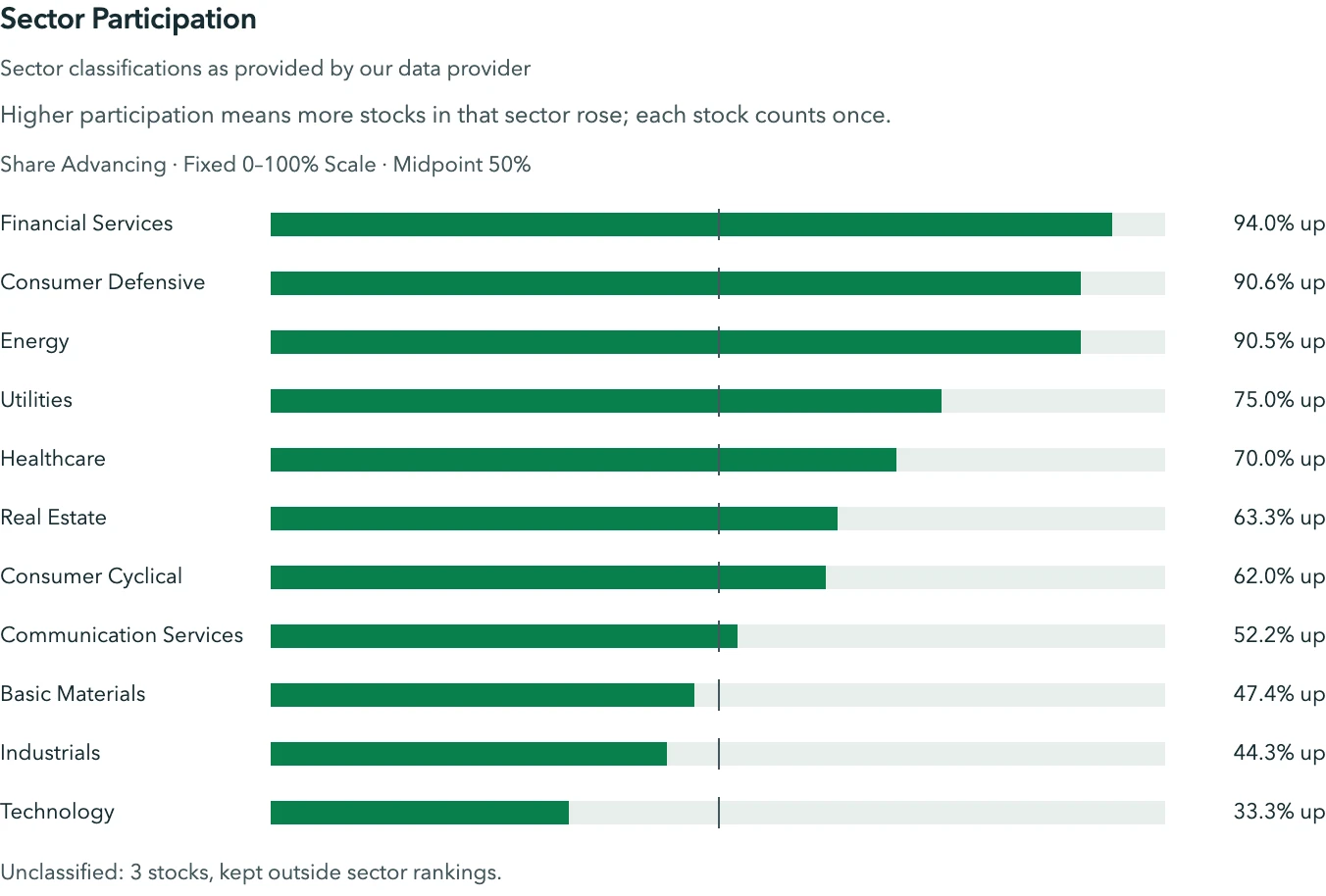
Financial Services had the widest participation, with 63 of 67 members up (94.0%), followed by Consumer Defensive (29 of 32) and Energy (19 of 21). By median return Consumer Defensive led at +1.18%, then Energy at +1.00%. The three sectors without a majority were Technology, Industrials and Basic Materials. Technology had 29 of 87 members up and a median of −1.16%. In the Nasdaq-100, 8 of 41 Technology members rose, with a median of −2.52%, while all 7 Consumer Defensive members rose. In the AI 30, 4 of 22 Technology names rose and none of the three Utilities did.
Crypto-related equities: one of seven rose
BTCS gained 0.98% and the other six fell, for a median of −3.34%; Bitmine was weakest at −4.72%. None is above its 20- or 50-day average and one is above its 200-day. Three are oversold: the Solana staking fund, the Ethereum trust and the Bitcoin trust. CNBC reported bitcoin below $70,000 for the first time since August, with a low of $67,632.68, and CoinDesk reported ether under $2,000.

Volume and momentum
SPY's own relative volume was 0.80x and its median member's 0.68x, so the day was quieter than usual; two names, Southern and Tyson, traded at twice their usual volume or more. Volume is unavailable for QQQ members. SPY's 14-day RSI eased to 47.1 from 48.5 and QQQ's to 42.8 from 45.4. Three S&P members are oversold (Axon, F5 and Nvidia), from 5 on Thursday, and 29 are overbought, from 27.
Not covered today
These dashboard sections are not covered: the Broad Or Narrow and Stock Return Distribution charts beyond the figures above, the AI 30 Health strip, the AI Ecosystem groups, the Sector Participation Strip and Sector × Lens table, the New Highs And Lows chart, the volume and momentum tables, the selected-stock charts, the Fund Bridge, Rotation, Big Moves, Dividends, Market History, Performance & DCA, Stock History, and the Correction Tracker and Economy pages.
Flows
Figures come from the day's options tape and the dashboard's flow labels. Sides are the tape's classifications, not confirmed purchases or sales. Size and side do not prove intent, the tape alone cannot separate multi-leg and financing trades from one-way trades, and flow is context, not a forecast. The market-level figures below count all options prints; Thursday's entry quoted large prints only, so the two sets of totals are not comparable.
Market level: a little below the recent median, with puts and calls near even
Total options premium was $44.30 billion, against $46.37 billion on Thursday and 0.95 times the median of the previous seven sessions ($46.87 billion). Puts were 49.3% of premium, down from 53.8% on Thursday and close to the seven-session median of 50.4%.
SPY's premium of $2.53 billion was 1.17 times its seven-session median, and its put share rose to 55.0% from 48.0%. Prints of $1 million or more in SPY numbered 105 and totalled $322.8 million, against 76 and $117.3 million on Thursday. QQQ's premium of $2.52 billion was 0.86 times its median, with a put share of 60.1%, close to Thursday's 59.1%. IWM's put share was 74.4% on premium 0.76 times its median. SMH's put share fell to 71.7% from 83.3%, on premium 0.71 times its median. The dashboard labels SPY's large-trade share High and QQQ's Normal, with QQQ's options pricing Elevated; large-trade share measures size against the fund's own history and says nothing about direction.
Sectors: Energy stands out, with Exxon Mobil behind it
Counting prints of $25,000 or more, Energy premium was $1.35 billion, 12.4 times its seven-session median, with a put share of 1.7%. One name stood behind it: Exxon Mobil's premium was $997.0 million, 41.1 times its own median, almost all in calls. We do not have the trade detail to say whether this was financing, dividend-related or one-way, so we read no direction into it. Industrials premium ran 1.37 times its median and Communication Services 1.13 times, the latter with a put share of 59.7% against a median of 35.3%. Technology premium was 0.70 times its median, at $6.39 billion, and its put share of 51.1% was below its median of 57.0%. On the day Technology had the weakest breadth, its options premium was lighter than usual and less tilted to puts than usual.
Single names: less premium in Nvidia, a higher put share in AMD and Broadcom
Nvidia's premium fell to $2.62 billion from $6.10 billion on Thursday, 0.71 times its seven-session median, with puts at 49.2%. Its prints of $1 million or more fell to 113 from 350. AMD's premium of $1.58 billion was 1.09 times its median, and its put share rose to 43.9% from 31.3%. Broadcom's put share rose to 41.9% from 23.6% on premium 0.70 times its median. Nebius premium was 1.90 times its median with a put share of 66.8%. ServiceNow's premium was 2.63 times its median and 88.3% of it was in puts, on a day the stock rose 1.58%. Meta's put share fell to 26.0% from 51.0% as the stock gained 2.90%. Outside equities, premium in the gold fund GLD was 2.11 times its median with a put share of 87.2%.
Large prints: index pairs again
All 15 of the largest regular-hours prints were S&P 500 index options at the 7000 and 8000 strikes, each carrying a floor-trade flag. The largest was 5,200 February 2027 7000-strike calls at 11:57 a.m. ET, classified at the bid, for about $357.4 million. In the same second 5,200 February 2027 8000-strike puts printed, classified at the ask, for about $241.8 million. At 11:50 a.m., 4,000 March 2027 7000 calls (classified at the ask, $292.0 million) printed alongside 4,000 March 2027 8000 puts (at the bid, $191.4 million), and 5,000 December 2026 7000 calls (at the bid, $287.2 million) alongside 5,000 December 8000 puts (at the ask, $234.2 million). Equal sizes at the same instant in a deep in-the-money call and a deep in-the-money put fit a packaged financing-type structure. The tape cannot confirm that, and either way these prints carry no market direction we can read. No single-stock print ranked among the 15.
Tying it in
Put share rose in the names that fell hardest (AMD, Broadcom, Nebius) and fell in Meta, which rose. That is what price alone would lead one to expect, and it adds little. Two readings add more. Overall premium and Technology premium were both below their recent medians on a day QQQ lost its 200-day average, so the tape does not show a rush of activity around that break. And SPY's put share and its count of million-dollar prints both rose while most S&P stocks advanced, which fits a market whose index and members moved apart.
Economy
Released or reported on Friday, November 13:
- Producer prices, October (Bureau of Labor Statistics): final demand rose 0.3% on the month after a revised 1.4% in September, and 6.5% over 12 months, the largest annual rise since November 2022. The consensus cited by CNBC was 0.4% and 6.6%. Excluding foods and energy the index rose 0.3% on the month and 5.0% on the year, matching the 0.3% consensus. Excluding foods, energy and trade services it rose 0.5% for a second month.
- Inside the report: goods rose 0.5%, with foods up 1.3% and energy down 0.1%. Services rose 0.2%, a fifth straight gain, and transportation and warehousing rose 2.0%.
- Fed speakers: San Francisco Fed President Mary Daly said her bias is that the Fed will, in all likelihood, need to raise its policy rate (Reuters). Boston Fed President Susan Collins said inflation is too high and appears to be broadening, as FXStreet reported from a Bloomberg TV interview. Dallas Fed President Lorie Logan said it is necessary to make policy more restrictive, not less (Dallas Fed text).
- Yields: the Treasury's par yield curve for Friday is unavailable to us tonight. Outlets reported the 10-year yield near 5.15% at the close (Yahoo Finance; CNBC had about 5.14%). A 2-year figure is unavailable.
- Fed pricing: CNBC reported a December rate increase as fully priced, about 87% for a quarter point and 13% for a half point.
Improved since the previous release: the monthly rise in producer prices slowed to 0.3% from a revised 1.4%, and the headline came in under the reported consensus.
Deteriorated: the 12-month rate of 6.5% is the highest since November 2022, the measure excluding foods, energy and trade services rose 0.5% for a second month, the reported 10-year yield rose, and three Fed presidents spoke in favor of tighter policy.
What it means for SPY and QQQ (our view): bull evidence: a monthly print under consensus, a rising majority of S&P stocks, and 8 new highs against one new low. Bear evidence: stocks opened higher on the report and closed lower, the reported 10-year yield ended above the 5.10% par close of Thursday's entry, and QQQ closed under its 200-day average. On Thursday we called the rate path the main risk to both funds; Friday gave us no reason to change that.
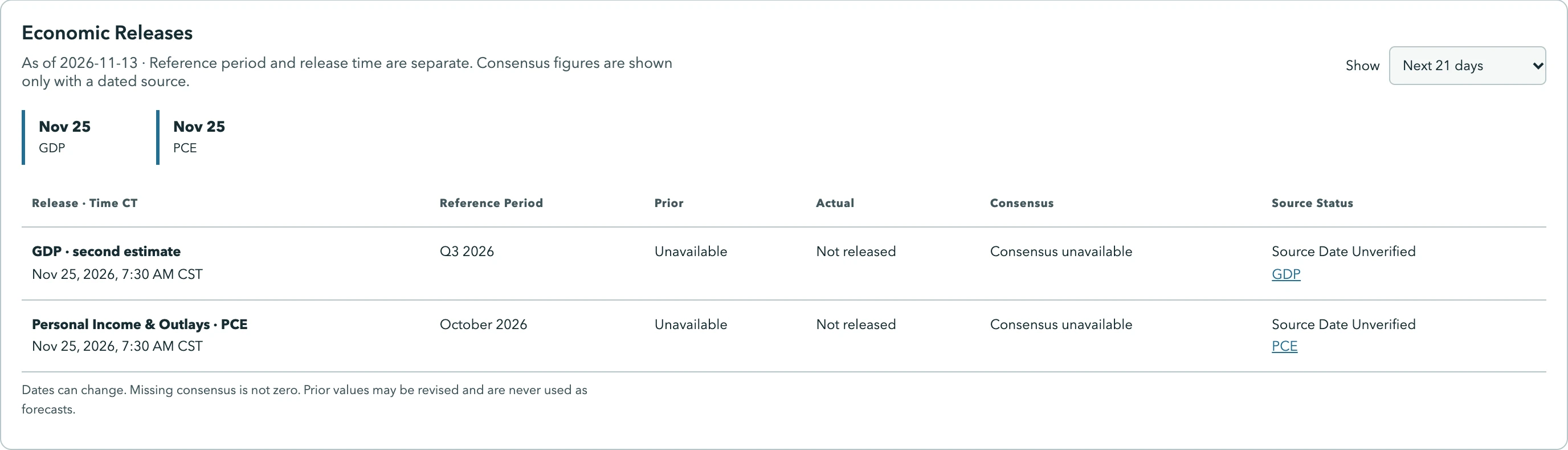
Next release that could change this: October retail sales, Tuesday, November 17, 08:30 ET (Census Bureau); then the Fed's minutes of its October 27–28 meeting, Wednesday, November 18, 14:00 ET. Fed Chair Kevin Warsh gives opening remarks at a San Francisco Fed conference on Monday, November 16, at 12:00 ET. The dashboard's Economic Releases table is dated November 13; its yield history is stale and is not used here.
Week in retrospect
The week by closes, from the prior Friday's $735.29 for SPY and $656.10 for QQQ:
- Monday, November 9: SPY $752.69 (+2.37%), QQQ $679.35 (+3.54%); 84.1% of S&P members up; AI 30 count above the 50-day: 5.
- Tuesday, November 10: SPY $749.92 (−0.37%), QQQ $674.76 (−0.68%); 49.1% up; count 4.
- Wednesday, November 11: SPY $759.81 (+1.32%), QQQ $690.38 (+2.31%); 66.0% up; count 7.
- Thursday, November 12: SPY $757.12 (−0.35%), QQQ $688.17 (−0.32%); 24.7% up; count 8.
- Friday, November 13: SPY $754.37 (−0.36%), QQQ $679.89 (−1.20%); 62.6% up; count 7.
SPY gained 2.59% on the week and QQQ 3.63%. Nvidia fell 12.75%, from $186.64 to $162.85.
The prior Friday's outlook (written for November 6; judged on closes November 9 to 13). Stance: "wait-and-see". Two of its six calls were graded in Monday's entry, the first a hit and the fourth a miss. The other four ran through Friday's close:
- "No SPY close below 730.38 on any session 2026-11-09 to 2026-11-13": hit; the lowest close was $749.92.
- "No QQQ close below 647.05 on any session 2026-11-09 to 2026-11-13": hit; the lowest close was $674.76.
- "SPY share above SMA200 stays at or above 50% on every session 2026-11-09 to 2026-11-13": hit; the lowest reading was 61.8%.
- "The highest-weighted scenario (base, 0.45) is the one realized by the 2026-11-13 close": miss. That outlook's bull case, weighted 0.25, was the one realized. No bear line was closed through, Friday's closes of $754.37 and $679.89 were above its bull levels of $742.21 and $664.52, and Monday met its breadth condition with 84.1% of S&P members up and a median gain of 2.03%.
Monday's outlook (judged on closes November 10 to 13). Stance: "constructive-leaning on broad exposure; wait-and-see on concentrated AI; CPI is the test".
- "SPY does not close below 741.95 on 2026-11-10": hit ($749.92).
- "No SPY close below 741.95 on any session 2026-11-10 to 2026-11-13": hit; the lowest close was $749.92.
- "No QQQ close below 662.64 on any session 2026-11-10 to 2026-11-13": hit; the lowest close was $674.76.
- "The share of SPY members above their 200-day average stays at or above 55% on every session 2026-11-10 to 2026-11-13": hit; the lowest reading was 61.8%.
- "QQQ closes above 681.1691 (about $681.17), its 200-day average as of Nov 9, on at least one session 2026-11-10 to 2026-11-13": hit, on Wednesday and Thursday.
- "The number of AI 30 names above their 50-day average on 2026-11-13 is at least 6 of 30 (above Nov 9's 5 of 30, 16.67%)": hit; 7.
- "The highest-weighted scenario (base, 0.45) is the one realized by the 2026-11-13 close": hit. No bear line was closed through, and SPY's Friday close was under that outlook's bull level.
Tuesday's outlook (closes November 11 to 13). Stance: "modestly bullish on the broad market with a named bear trigger; concentrated AI the laggard until its repair count turns; PPI on Friday is the next test".
- "No SPY close below 741.95 on any session 2026-11-11 to 2026-11-13": hit.
- "No QQQ close below 662.64 on any session 2026-11-11 to 2026-11-13": hit.
- "The share of SPY members above their 200-day average stays at or above 55% on every session 2026-11-11 to 2026-11-13": hit.
- "QQQ closes above 681.4156 (about $681.42), its 200-day average as of Nov 10, on at least one session 2026-11-11 to 2026-11-13": hit.
- "The number of AI 30 names above their 50-day average on 2026-11-13 is at least 5 of 30 (above Nov 10's 4 of 30, 13.33%)": hit; 7.
- "NVDA's close on 2026-11-13 is at or above 168.89": miss; $162.85.
- "The highest-weighted scenario (base, 0.50) is the one realized by the 2026-11-13 close": hit.
Wednesday's outlook (closes November 12 and 13). Stance: "neutral at the index level for Thu-Fri with a named bear trigger; constructive on the broad market beneath the leader; cautious on concentrated AI until Nvidia's leadership question is resolved".
- "No SPY close below 741.95 on 2026-11-12 or 2026-11-13": hit.
- "No QQQ close below 662.64 on 2026-11-12 or 2026-11-13": hit.
- "QQQ's 2026-11-13 close is at or above 681.71185 (its stored 200-day average as of 2026-11-11)": miss; $679.89, which is $1.82 under it.
- "The share of SPY members above their 200-day average stays at or above 55% on 2026-11-12 and 2026-11-13": hit; 61.8% and 63.6%.
- "The number of AI 30 names above their 50-day average on 2026-11-13 is at least 7 of 30": hit; exactly 7.
- "NVDA's lowest close on 2026-11-12 and 2026-11-13 is at or above 156.20": hit; $162.85.
- "The highest-weighted scenario (base, 0.45) is the one realized by the 2026-11-13 close": miss. That outlook's bear case, weighted 0.40, was the one realized, because QQQ's Friday close was under $681.71.
Thursday's outlook (closes November 13, 16 and 17; one of three sessions is in). Stance: "modestly bullish on SPY and QQQ through the 2026-11-17 close with a named bear trigger; cautious on concentrated AI until NVIDIA closes above 168.89 and reports".
- "No QQQ close below 679.83 on 2026-11-13, 2026-11-16 or 2026-11-17": still open. Friday's close of $679.89 held it by six cents, and the after-hours trade is below it.
- "No SPY close below 741.95 on 2026-11-13, 2026-11-16 or 2026-11-17": still open; $754.37 so far.
- "QQQ closes at or above 681.9866 (its 200-day average as of 2026-11-12) on each of 2026-11-13, 2026-11-16 and 2026-11-17": miss, already decided by Friday's close.
- "The share of SPY members above their 200-day average stays at or above 55% on each session 2026-11-13 to 2026-11-17": still open; 63.6% so far.
- "The number of AI 30 names above their 50-day average on 2026-11-17 is at least 8 of 30": still open; it was 7 on Friday.
- "NVDA's lowest close on 2026-11-13, 2026-11-16 and 2026-11-17 is at or above 156.20": still open; $162.85 so far.
- "The highest-weighted scenario (base, 0.45) is the one realized by the 2026-11-17 close": still open; no bear trigger so far.
Thursday's view of the producer-price report read: "A print above the reported consensus with the 10-year par yield above 5.10% fits the bear path; a print at or under it with yields no higher supports base or bull. No level forecast." The print was at or under consensus on the monthly rates, the par yield is unavailable, outlets reported the 10-year higher, and both funds fell. Our two branches did not include a soft monthly print with higher yields, so we count that as a miss in how the test was built.
Of the 25 calls decided at Friday's close, four from the November 6 outlook and 21 from Monday's, Tuesday's and Wednesday's, 21 were hits and 4 were misses. Thursday's stand at one miss and six still open.
What we learned.
- The broad-market calls were right all week. Monday's opening prices held on every close, and the share of S&P members above their 200-day average never fell under 61.8%.
- Three of the four misses were in the concentrated part of the market: Nvidia holding its reclaim level, and QQQ holding its 200-day average on Friday, which also decided Wednesday's base case. The fourth was the November 6 base case, which the week's gains took into that outlook's bull case. Wednesday night's shift to neutral, with a 200-day test added, described Friday better than Thursday night's move back to a bullish lean.
- On Thursday we treated one day of gains in AMD and Broadcom as evidence that the index could hold without Nvidia, on a day only 24.7% of S&P stocks rose. Both reversed on Friday. A single session of leadership from a few names is thin evidence, and we should weight it that way.
- Conditions on an economic release need a branch for a mixed result. A soft monthly number with a high annual rate and a higher 10-year yield is one.
Outlook
Scenarios with conditions, not forecasts; the weights are our subjective leanings and sum to 100. They cover two sessions, Monday, November 16 and Tuesday, November 17, ending before Nvidia's results that evening, so exactly one will have happened; evaluate bear first, then bull, else base. The levels are fixed at Friday's values. Thursday's calls stay open through the same Tuesday close and are tracked separately.
How the day's main items move the weights. The session itself is the largest change: QQQ closed under its 200-day average, which lifts the bear case to 40% from 30%. The sell-off in AI hardware reversed Thursday's gains in AMD and Broadcom, one of the three reasons the bull case had been raised, and the after-hours tape, another of them, was lower this time, so it falls to 15% from 25%. The HSBC downgrade leaves Nvidia under its reclaim level with its report still ahead, and keeps it on the laggard list in every case. The producer-price report showed a softer month and a 6.5% annual rate. Outlets reported a higher 10-year yield. Rates stay a bear-side condition. The calendar puts retail sales inside the window and Nvidia's results, the Fed's minutes and the reported Anthropic pricing just after it, which argues for the base case at 45%. After hours, QQQ's $674.25 is below Thursday's bear line and above the new one; SPY's quote was unavailable and index futures were not pulled.
Our lean is neutral at the index level. The bull and base cases carry 60% of our weight, short of the 65% that would support a bullish lean, and the base case allows QQQ to stay under its 200-day average. The broad S&P 500 reading stays constructive.
Bear — "Friday's lows give way" (about 40%, from 30%).
- Trigger: any QQQ close below $671.68 or any SPY close below $745.20, Friday's lows, on Monday or Tuesday.
- Path: QQQ from its after-hours price through Friday's low toward $662.64, Monday November 9's open, with the November 6 close of $656.10 beneath. SPY through Friday's low toward $741.95, with its 200-day average at $731.92 beneath. The accompanying signs would be Nvidia closing below its hold level and a reported 10-year yield above Friday's.
- Leaders and laggards: relative leaders would be Friday's widest sectors, Financial Services, Consumer Defensive and Energy. Laggards: AMD, Dell, Nebius, CoreWeave, Nvidia and the memory and optical names.
- Window: either close, Monday, November 16 or Tuesday, November 17.
- Invalidation: no such close through Tuesday.
Bull — "QQQ back above its 200-day, SPY back above its 20-day" (about 15%, from 25%).
- Trigger: no bear trigger, and on Tuesday QQQ closes above $682.24 and SPY above $759.02 (rises of 0.35% and 0.62% from Friday's closes).
- Path: QQQ recovers its after-hours loss, then Thursday's bear line and its 200-day average, toward Friday's high of $688.75. SPY through its 21-day exponential average at $758.09 and its 20-day toward Friday's high of $760.12, with the 50-day at $764.43 above. The conditions would be a retail-sales report that does not lift yields further and a stop to the selling in AI hardware.
- Leaders and laggards: Friday's AI 30 gainers (Meta, Adobe, ServiceNow, Microsoft, Salesforce) and Apple lead. Nvidia can lag; the case needs the AI 30 count at 7 or more.
- Window: Tuesday's close.
- Invalidation: a bear trigger at either close, or either fund at or below its level on Tuesday.
Base — "between Friday's lows and the averages" (about 45%, unchanged).
- Trigger: no bear trigger, and Tuesday's closes do not clear both bull levels.
- Path: QQQ holds above Friday's low and typically stays under its 200-day average. SPY holds above Friday's low and typically under its 20-day, around its 9-day exponential average of $754.26. A Tuesday close above one of the two bull levels but not both is still the base case. Nvidia trades between its hold and reclaim levels into its report.
- Leaders and laggards: the median stock and the sectors with wide participation lead; Technology, where 29 of 87 members rose on Friday, lags; the AI 30 count stays near 7.
- Window: through Tuesday's close.
- Invalidation: a bear trigger, or Tuesday closes above both bull levels.
Before turning constructive on concentrated AI we would want: QQQ closing back above its 200-day average and holding it for more than one session; Nvidia closing above its reclaim level; the AI 30 count back to 8 and rising toward 10; Tuesday's Nvidia report confirming the roadmap and guidance under interim CEO Colette Kress; and a reported 10-year yield no higher than Friday's.
Warning signs that would strengthen the case for caution: a QQQ close below Thursday's bear line, then Friday's low; a SPY close below Friday's low, then $741.95; Nvidia closing below its hold level; S&P members above the 200-day under 55% (Friday: 63.6%); new lows exceeding new highs (Friday: 8 highs, one low); the AI 30 count at 6 or fewer; a second close for QQQ under its 200-day average with fewer than half of S&P members advancing.
Dip, wait, or trim? The week ended with two different markets. The average S&P stock rose on Friday, most sectors advanced, and nearly two-thirds of members are above their 200-day average. The concentrated AI group fell again, and it took QQQ under its 200-day average. Dip-buyers in the broad market would want to see breadth stay above half and SPY hold Friday's low. Dip-buyers in AI would want QQQ back above its 200-day average and Nvidia above its reclaim level, and they have Tuesday evening's report to wait for. The case for trimming concentrated AI would rest on a QQQ close below Friday's low or Nvidia below its hold level, and the case for trimming broad exposure on a SPY close below $741.95. The case for waiting rests on the two sessions left before the week's largest event.
Key dates (times ET; dates can change; † = as reported, not official): Mon Nov 16, 12:00 — Fed Chair Kevin Warsh, opening remarks. Tue Nov 17, 08:30 — October retail sales; after the close — Nvidia results, call 5:00 p.m. Wed Nov 18, 14:00 — FOMC minutes; Anthropic IPO, reported by CNBC to be scheduled to price†. Thu Nov 19, 08:30 — weekly jobless claims; Walmart results. Mon Nov 30 — MSCI drops Strategy after the close†. Thu Dec 3 and Thu Dec 10 — requested Senate Banking hearings (Jensen Huang; Howard Lutnick). Dec 8–9 — FOMC meeting.
Final summary
- Friday's lows: $671.68 for QQQ and $745.20 for SPY. A close under either on Monday or Tuesday is the bear trigger. QQQ's after-hours trade was $2.57 above its line.
- QQQ and its 200-day average at $682.24. A Tuesday close back above it, with SPY above $759.02, is the bull case. Until then the index reading is neutral and the broad-market reading constructive.
- Tuesday, twice. Retail sales at 08:30 ET meets a 10-year yield reported near 5.15%. Nvidia reports after the close, with $168.89 the level to reclaim and $156.20 the level to hold.
Correction, Nov 21, 2026: After this post was published, our data source revised SPY's Nov 13 low from $745.20 to $747.88. We have left $745.20, and the trigger levels built on it, as published so the record of our calls is unchanged.