
Executive summary
Nvidia's 8-K, accepted by the SEC at 8:52 a.m. ET on Thursday, says the board accepted Jensen Huang's resignation as president, CEO and director on November 11, effective immediately. Nvidia CFO Colette Kress is now interim CEO, Harvey C. Jones became board chair, and results stay on Tuesday, November 17. The filing gives no reason. NVIDIA opened 13.08% below Wednesday's close and finished at $166.19, down 4.34%. SPY lost 0.35% to $757.12 and QQQ 0.32% to $688.17; AP reported the S&P 500 was down nearly 1% early.
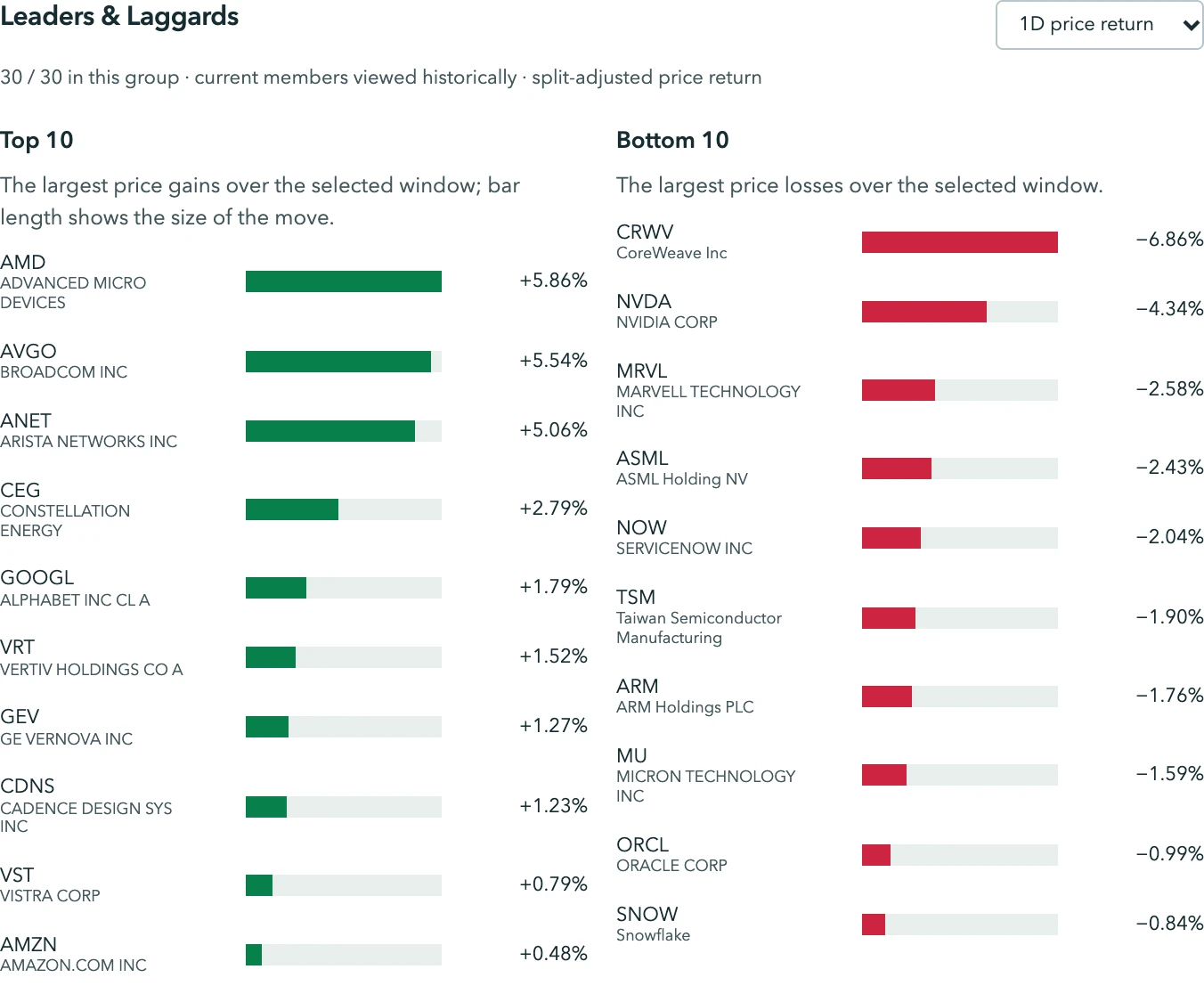
Two things happened beneath those small losses. A few large technology names rose: AMD gained 5.86% and Broadcom 5.54%, moves AP reported alongside hopes that rival chipmakers benefit; Arista rose 5.06%, which no outlet tied to Nvidia. And most other stocks fell: 377 of 503 S&P 500 members declined, the median stock lost 0.76%, and Nebius dropped 16.84% after trimming its 2026 revenue view and raising capital spending, with CoreWeave down 6.86%. The 10-year Treasury par yield closed at 5.10%, from 4.98% on November 10.
After the close Cerebras, another non-Nvidia chip supplier, rose 18.34% after results and a Microsoft contract, as reported; QQQ's last after-hours trade was 0.40% above its close and SPY's 0.26% above, and by CNBC's 7:24 p.m. ET update S&P 500 futures were up 0.4% and Nasdaq-100 futures 0.6%. Friday brings October PPI at 08:30 ET and five Fed speakers. Our view: the open question at the top of the index is now a filed fact and the index absorbed it, so we lean modestly bullish on SPY and QQQ through Tuesday's close, with 70% of our weight on the bull and base cases and a named bear trigger, a QQQ close below $679.83, Thursday's low. The lean is no stronger because three in four stocks fell and the 10-year yield closed above 5% for the first time this month.
Since the close
Times are Eastern. Prices are final after-hours trades against Thursday's regular close; futures and Asian index moves are as reported; results and call figures are company statements.
- 4:02 and 4:06 p.m. — Applied Materials and Cisco results; 4:30 p.m. calls. Applied Materials reported revenue of $10.41 billion and said on its call that it expects wafer-fab-equipment spending to grow more than 30% in 2027. Its shares were down about 1.6% at 4:29 p.m. (Investing.com) and ended at $383.58, up 0.69%. Cisco raised its hyperscaler AI-infrastructure revenue target to $9 billion from $7.5 billion and said product gross margin fell 350 basis points on hardware mix and memory costs. Outlets had the stock up between about 2% and 4.9% early; by 7:59 p.m. it was $101.50, 0.50% below its close. No outlet gave a definitive cause for the fade.
- After 4:00 p.m., call at 5:00 p.m. — Cerebras. The AI-chip maker reported third-quarter core revenue of $230.9 million, up 70%, and raised its 2026 core revenue outlook to $940 to $960 million. Cerebras CEO Andrew Feldman said Microsoft signed in October as its third hyperscaler customer, as reported by CNBC. The stock was up 12% to 13% in the first hour and ended at $115.68, up 18.34% from $97.75. It is outside the dashboard's lists; it matters here as another non-Nvidia chip supplier.
- By about 7:15 p.m. — Senate Banking request (time stamp of the Reuters report we found). Senate Banking Committee Chair Tim Scott asked former Nvidia CEO Jensen Huang to testify on December 3 and Commerce Secretary Howard Lutnick on December 10; the concerns he cited rest on allegations that remain unproven. No new board, succession or guidance news from Nvidia was found. NVDA's last after-hours trade was $167.84, up 0.99%, on 13.1 million shares, 5.13 times the median after-hours volume of the previous 20 sessions; its high was $168.92 in the 7:05 p.m. bar.
- Through 8:00 p.m. — AI hardware and the funds. Vertiv rose 3.36%, Marvell 2.4% and Micron 2.18%; CoreWeave and Nebius each gained about 1.2%; AMD slipped 0.41%, while Broadcom added 0.67% and Arista 0.34%. Of 26 AI 30 names with a fresh quote, 22 rose, 3 fell and 1 was flat, for a median of +0.73%. No outlet reported a driver for the hardware gains. QQQ's last trade was $690.90, up 0.40%, after a high of $693.40 in the 6:40 p.m. bar. SPY's last trade at 8:00 p.m. was $759.06, up 0.26%, with a high of $760.43 in the 7:05 p.m. bar.
- 6:00 to 7:24 p.m. — index futures, as reported. Futures reopened about 0.2% higher at 6:00 p.m. (CNBC). By CNBC's 7:24 p.m. update S&P 500 futures were up 0.4% and Nasdaq-100 futures 0.6%. South Korea's Kospi was up 2.79% at 7:10 p.m. and Japan's Nikkei opened 1.43% higher (CNBC).
- Settled at 2:30 p.m., no later headline — oil. WTI settled up 2.55% at $88.74 and Brent up 3.3% at $95.82 (CNBC), reported as following President Trump's post that the US does not need a deal with Iran.
- Friday's setup. October PPI is due at 08:30 ET. The consensus reported by CNBC and FXStreet is +0.4% on the month after +1.3% in September and 6.6% on the year, with core at +0.3% and 5.0%. Boston Fed President Susan Collins, Dallas Fed President Lorie Logan, Fed Vice Chair for Supervision Michelle Bowman, San Francisco Fed President Mary Daly and Fed Vice Chair Philip Jefferson speak, as reported.
- Tie to the Outlook. No after-hours price sits beyond a trigger in the new scenarios below. QQQ's $690.90 is 0.52 points above the $690.38 bull level set on Wednesday but 3.66 points below Thursday's high of $694.56, the new bull level. SPY's $759.06 is below both Wednesday's $760.20 and the new $763.04. NVDA's $167.84 is 1.05 points under the $168.89 it needs to reclaim. Applied to Thursday's closes, the reported futures gains of 0.4% and 0.6% also stay below $763.04 and $694.56. The evening adds a little to the bull case, and PPI is its first test.
Section by section
Pulse: why did the index barely move when most stocks fell?
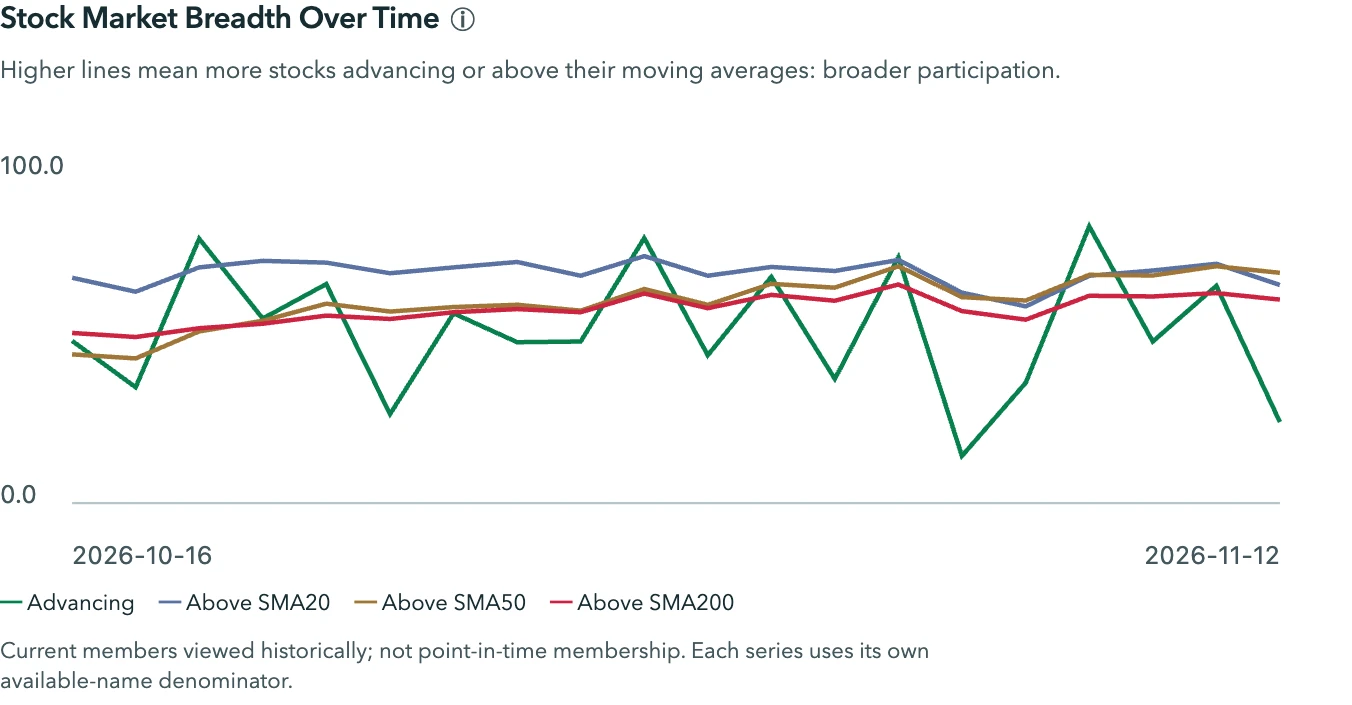
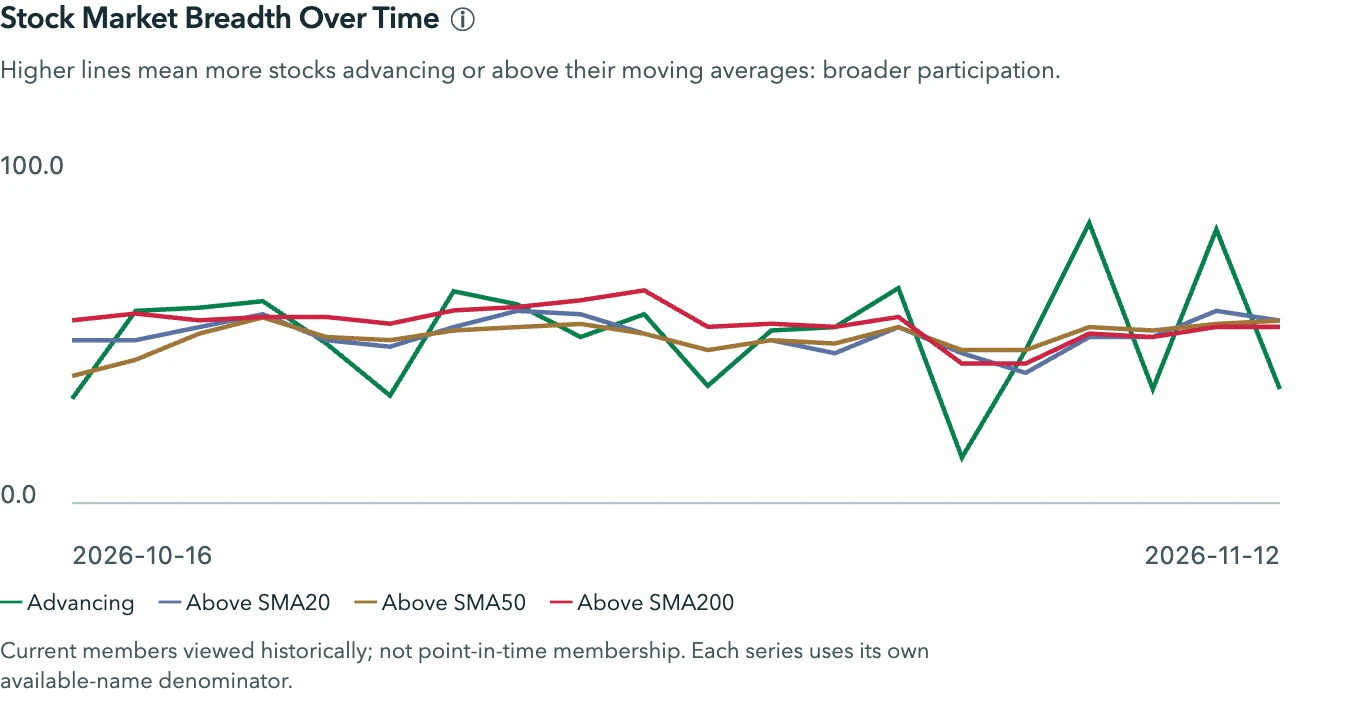
SPY: −0.35%, 24.7% of 503 members advancing (124 up, 377 down, 2 unchanged), 66% / 70% / 62% above the 20-, 50- and 200-day averages. QQQ: −0.32%, 34.7% advancing (35 of 101), 55% / 55% / 54%. AI 30: 14 of 30 up, 33% / 27% / 47%. Crypto-related equities: 0 of 7 up. The S&P's advancing share was the second-lowest of the 20 sessions the Breadth History shows, after November 5's 14.3%. A fund that falls a third of a percent while three in four members fall is being held up by its largest weights. We think that meant AMD, Broadcom, Alphabet and Tesla set against NVIDIA; contributions are unavailable, so that is a view, not a measurement.



The session: a lower open, a recovery, and QQQ's 200-day average tested
SPY opened at $753.98, 0.77% below Wednesday's close, ranged $753.67 to $763.04 and closed at $757.12, 0.42% above its open. QQQ opened 1.46% lower, ranged $679.83 to $694.56 and closed at $688.17. QQQ's low was 2.16 points under its 200-day average of $681.99; the close was 6.18 points above it. Wednesday's bear lines held so far: SPY closed 15.17 points above $741.95 and QQQ 25.53 points above $662.64. The Friday-only test, QQQ at or above $681.71, stands 6.46 points to the good after one session. Neither bull level ($760.20 for SPY, $690.38 for QQQ) was met at the close.
How deep is the correction?
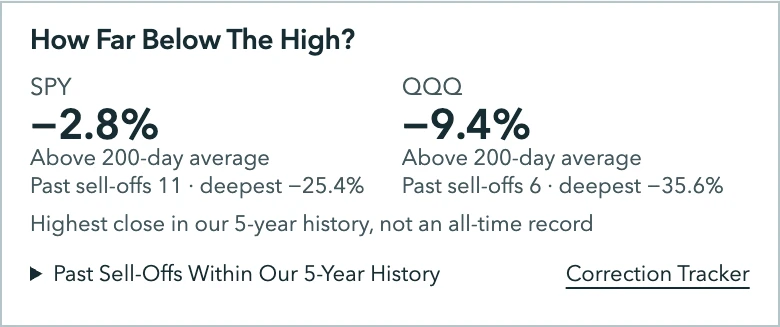
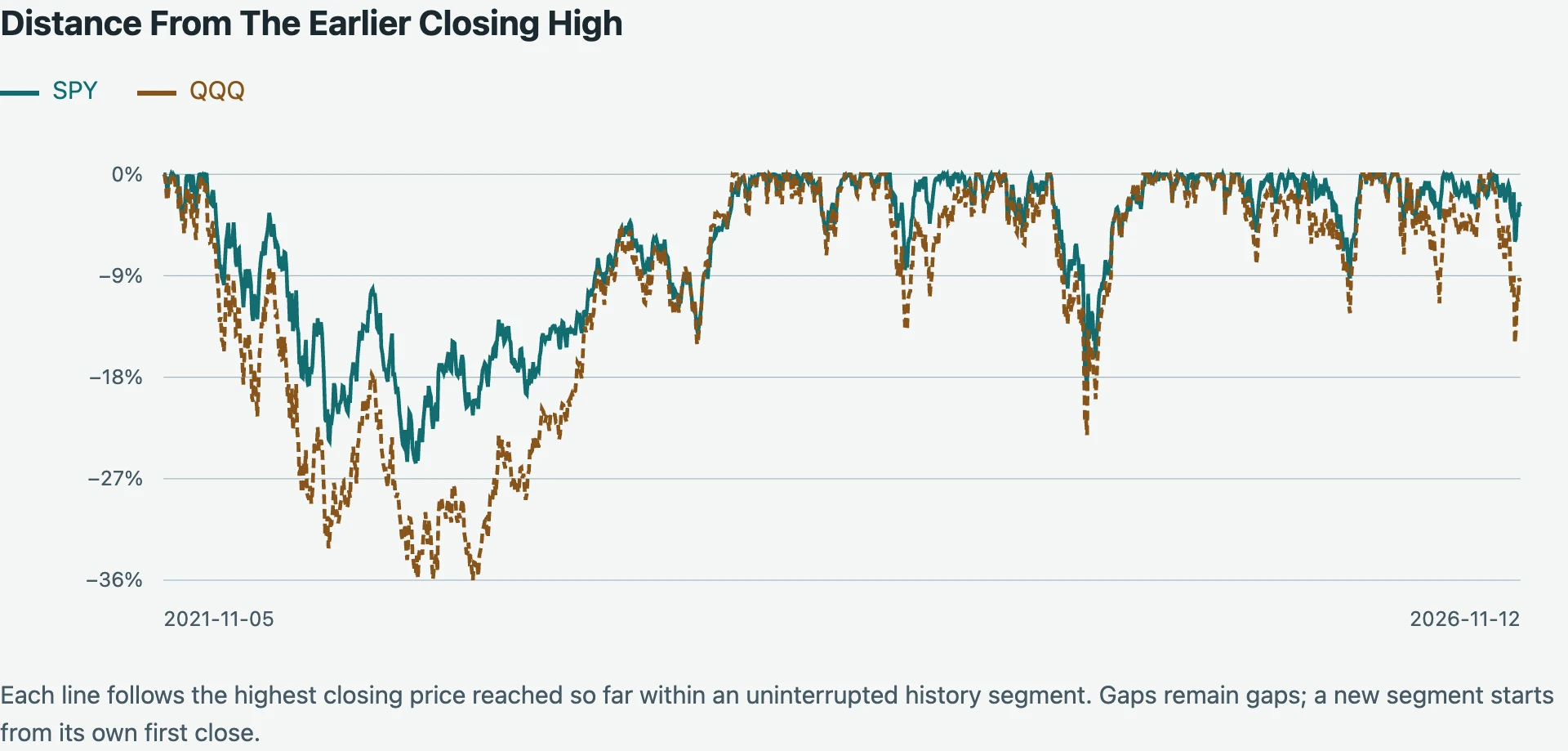
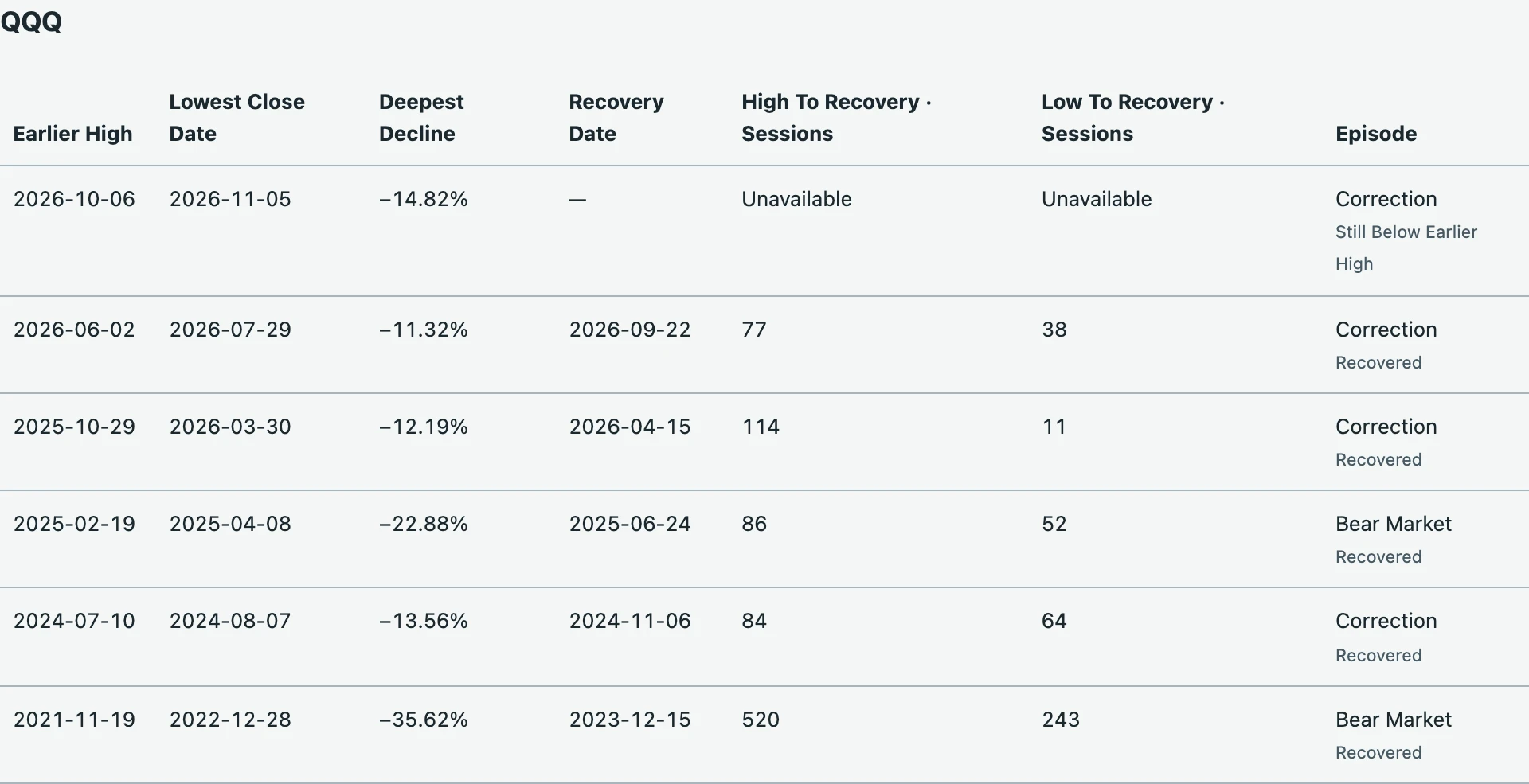
SPY closed 2.82% below its October 6 closing high of $779.09 and QQQ 9.41% below $759.66, from 2.47% and 9.12% on Wednesday. The Correction Tracker keeps QQQ's episode open at a deepest decline of 14.82% on November 5; SPY has no open decline of 10% or more. Both funds are above their 200-day averages, SPY by 3.49% and QQQ by 0.91%.
AI 30 Health: the count rose to eight
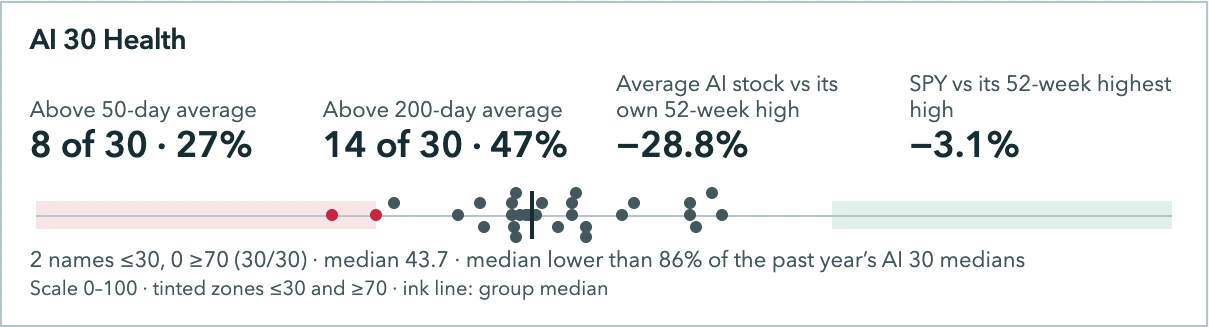
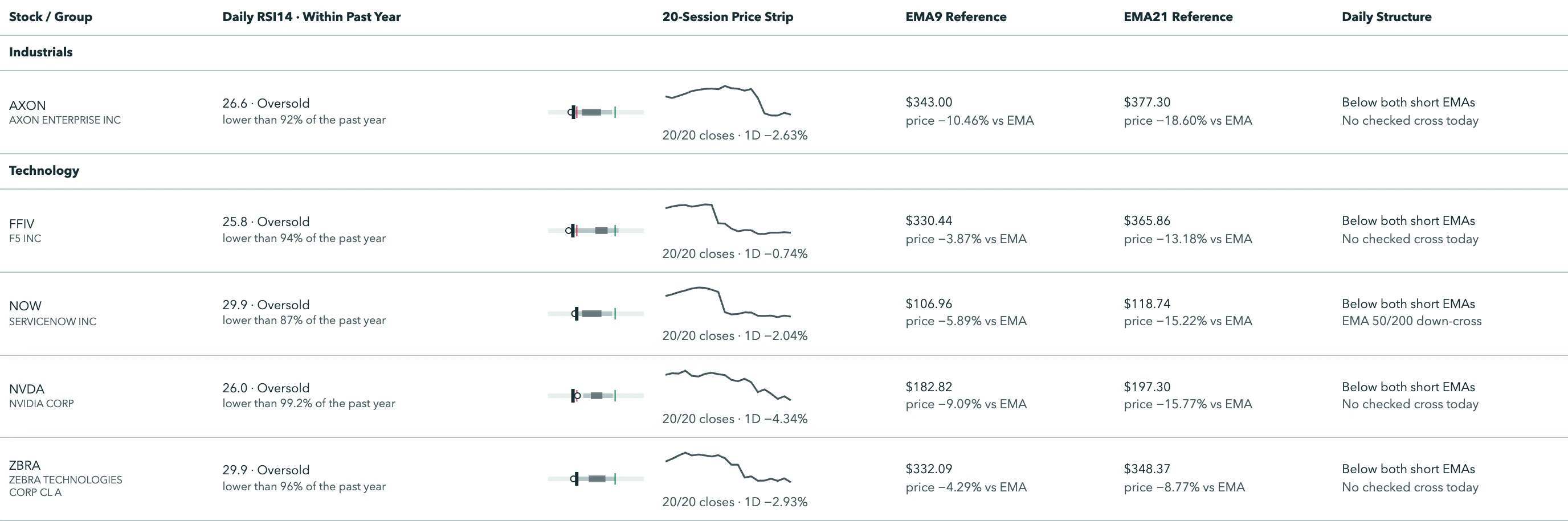
We track how many of the 30 AI names sit above their 50-day average as a count of repair. It rose to 8 of 30 (27%) from 7, with Broadcom joining; 14 are above their 200-day (47%, from 13). The average AI stock is 28.8% below its own 52-week high, an average of distances and not a basket return. Wednesday's requirement was the count holding at 7 or more and rising toward a third, which would be 10; one session in, it has. Two names are oversold, NVIDIA (RSI 26.0) and ServiceNow, and the group's median RSI of 43.7 is lower than 86% of the past year's AI 30 medians. The strip's SPY figure (3.1% below its 52-week highest high) uses intraday highs, unlike the closing-high figure above.
Broad or narrow? Narrow, and SPY's first down day this month ahead of its median stock
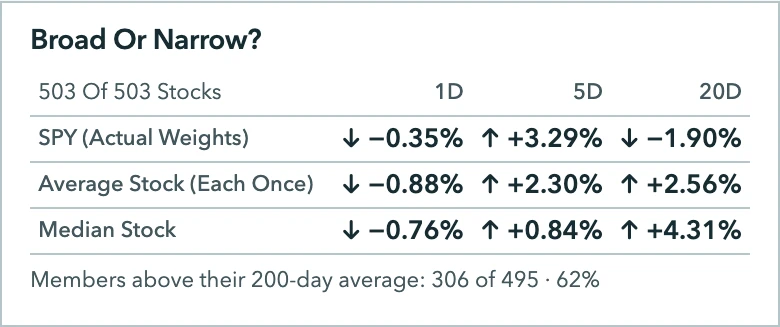
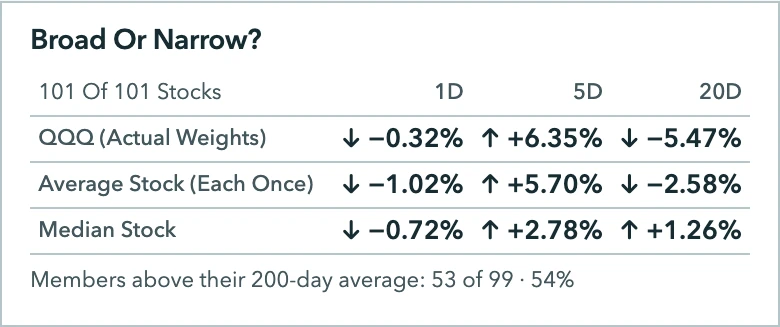
SPY's −0.35% compares with −0.88% for its average stock and −0.76% for its median. QQQ's −0.32% compares with −1.02% and −0.72%. On November's three earlier down days (the 2nd, 5th and 10th) SPY fell more than its median stock, as on November 10 (fund −0.37%, median 0.00%). When the fund sits above both on a down day, the largest names lost less than the rest, or gained. Over 20 sessions the gap still runs the other way: SPY is −1.90% while its median member is +4.31%.
Distribution and breadth history: a lockstep decline
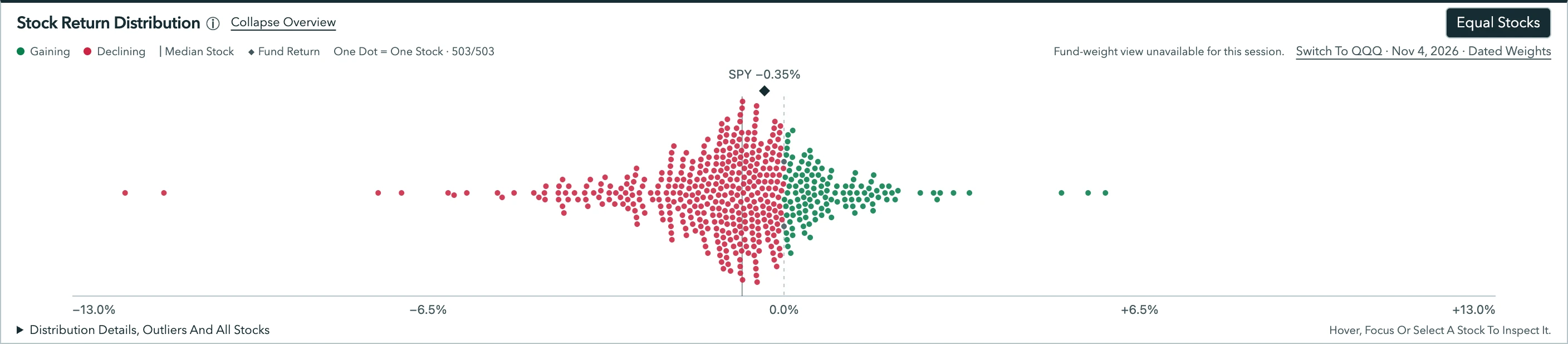
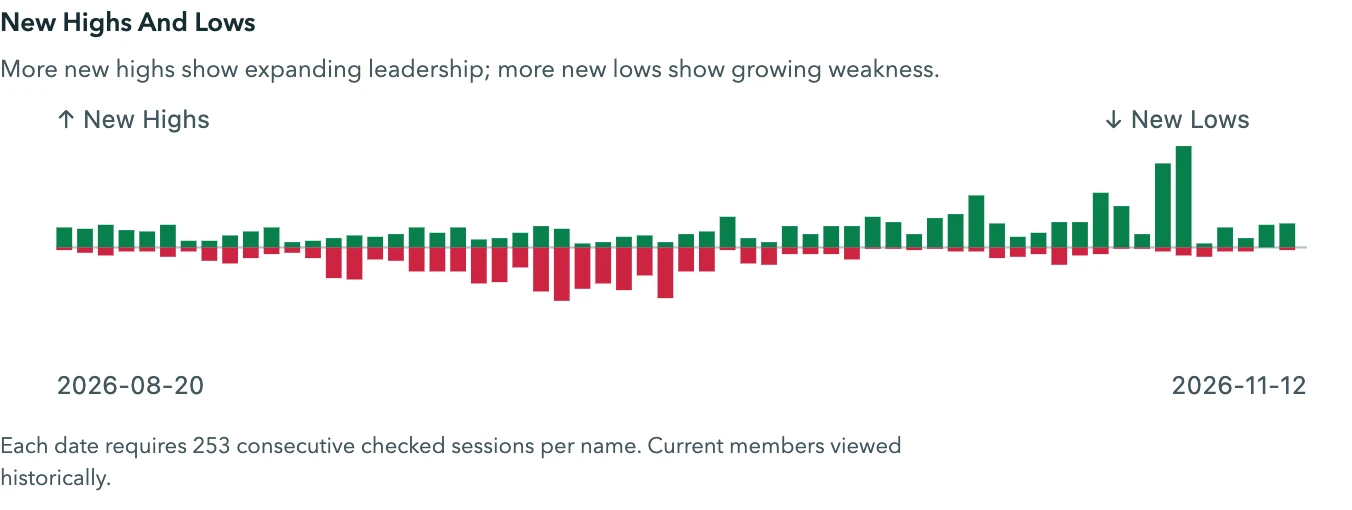
S&P member dispersion fell to 1.70 percentage points, the 17th percentile of the past year, from 2.30 (59th) on Wednesday; the Nasdaq-100's fell to 2.60, the 43rd percentile, from 4.14. Low dispersion on a day 377 members fell means most stocks moved down together by similar amounts. The longer measures gave back a little: 61.8% of S&P members (306 of 495) are above their 200-day average, from 63.8%. Neither of Wednesday's warning lines (55% above the 200-day, new lows exceeding new highs) was crossed: there were 18 new 52-week highs, among them Apple, Costco and Eli Lilly, against 2 new lows, Aptiv and NVIDIA. The Nasdaq-100 had four new highs and one new low (NVIDIA); the AI 30 had the same one low; the crypto list had neither. On the AI 30 and crypto breadth charts, 14 of 30 and 0 of 7 advanced; the dated readings table repeats these values.
Leaders and laggards: AMD and Broadcom up, Nebius and CoreWeave down
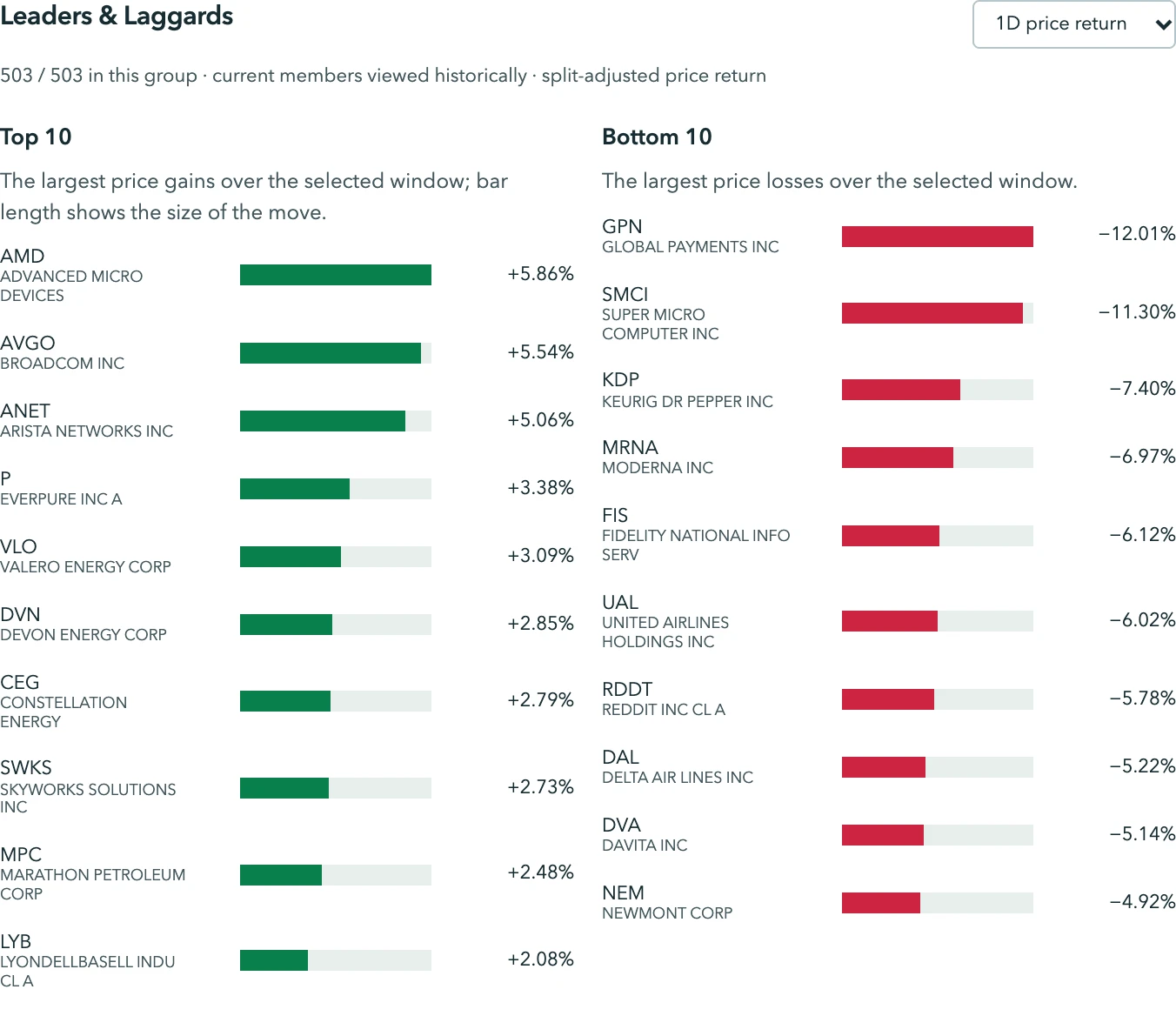
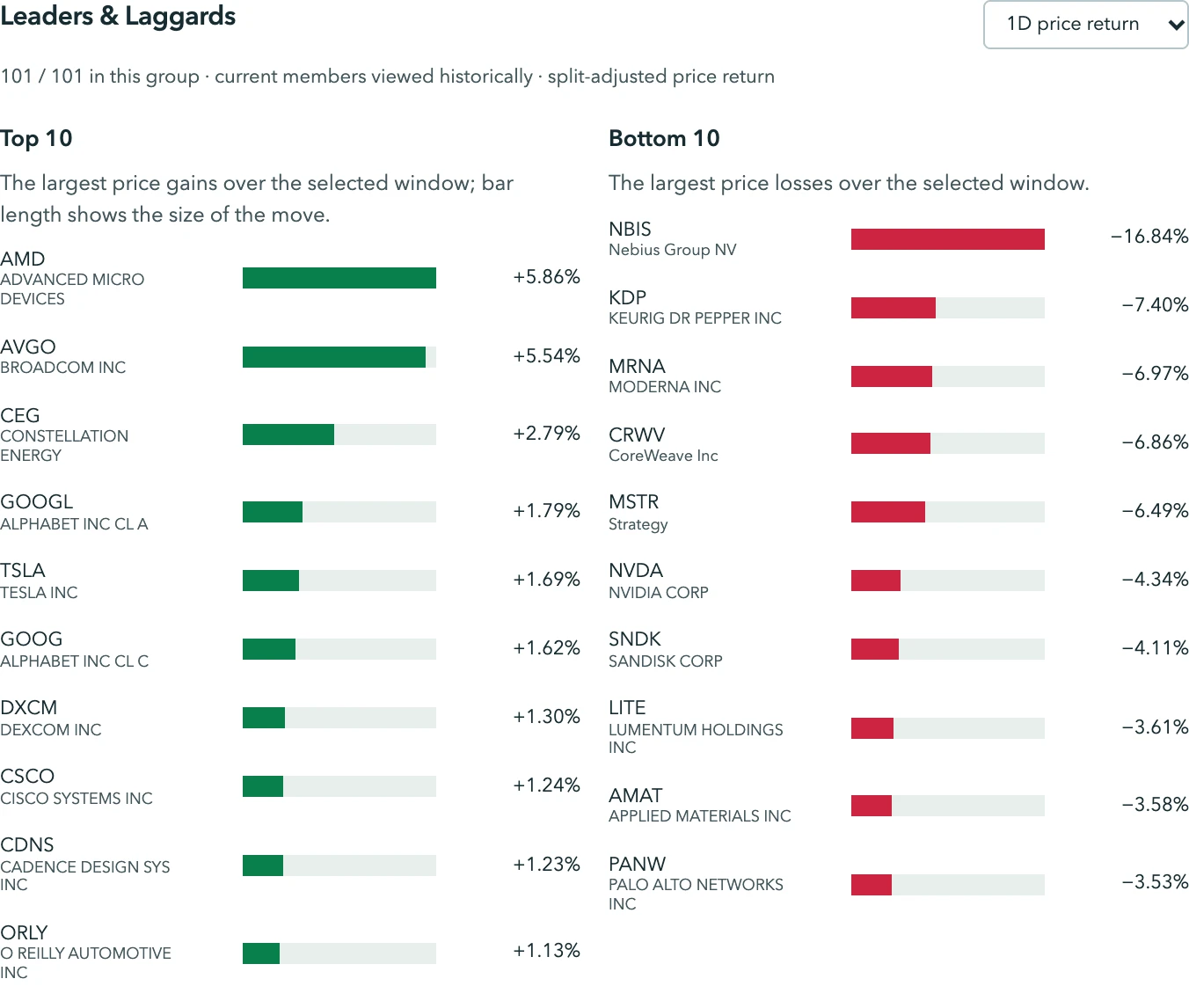
S&P leaders: AMD +5.86%, Broadcom +5.54%, Arista +5.06%, Everpure +3.38%, Valero +3.09%. Laggards: Global Payments −12.01%, Super Micro −11.30%, Keurig Dr Pepper −7.40%, Moderna −6.97%, Fidelity National Information Services −6.12%. In the Nasdaq-100, Nebius (−16.84%) was weakest, CoreWeave (−6.86%) fourth-weakest and NVIDIA (−4.34%) sixth. In the AI 30 the top three matched the S&P's, and CoreWeave, NVIDIA and Marvell (−2.58%) trailed.
The news behind the largest moves, as reported and not as established causes. William Blair upgraded AMD and cut Nvidia to Market Perform (analyst opinion, CNBC); no outlet tied Arista's gain to Nvidia. Nebius said 2026 revenue would land at the low end of $3.0 to $3.4 billion and raised 2026 capital spending to about $27 billion; CNBC reported the fall as following those two changes. Reuters reported Global Payments' fall as following the end of talks by two private-equity firms to take it private. Super Micro's fall was reported alongside a Bloomberg report, citing a person familiar, that federal prosecutors are examining whether its servers were diverted to China; no charges in this inquiry have been reported.
What about Nvidia?
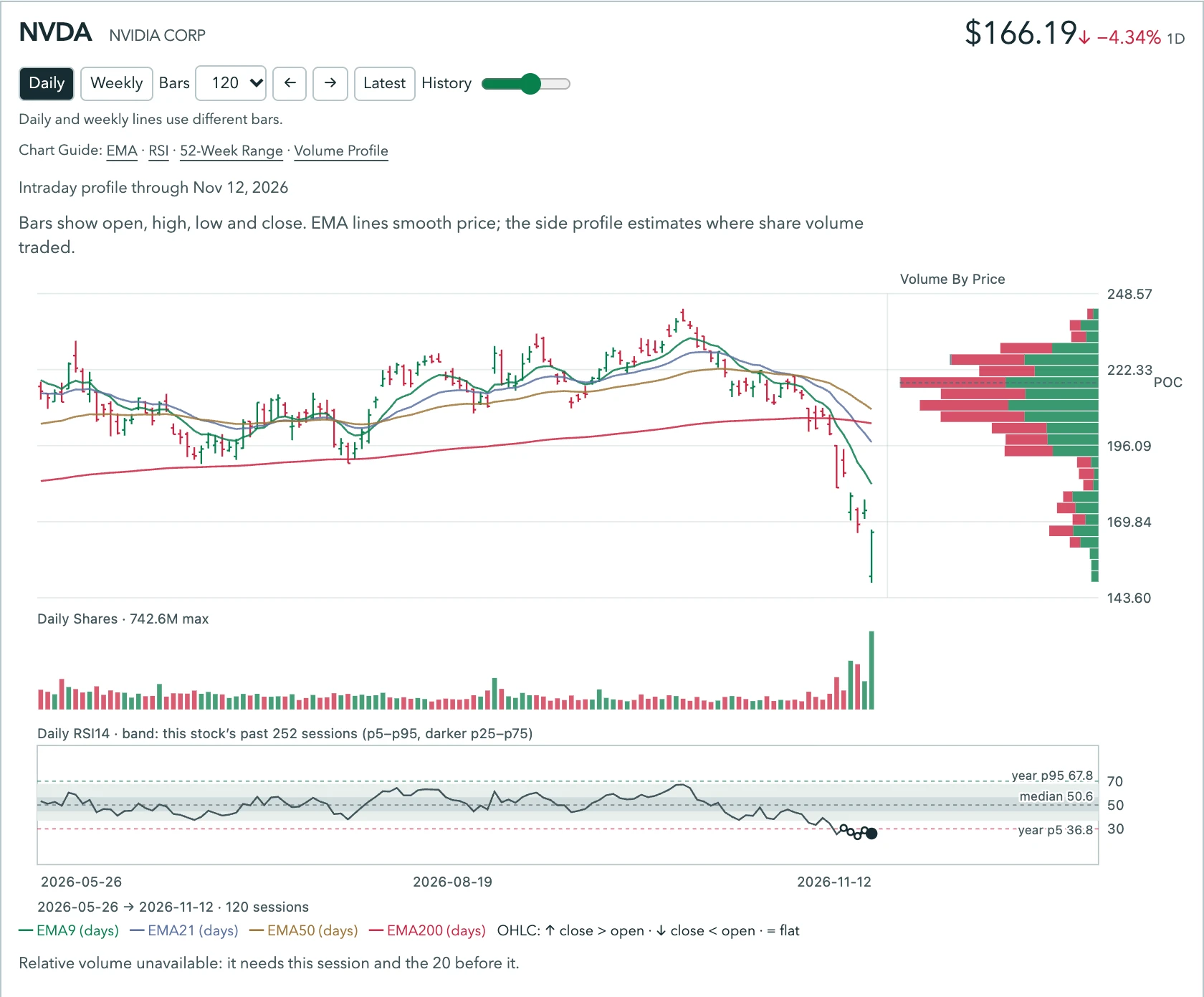
Nvidia CFO Colette Kress, in that role since 2013, is interim CEO and stays CFO until a successor is named. Harvey C. Jones, a director since 1993, holds what the company's release calls its first-ever chair role. The filing states no reason, and CNBC's description of an ouster is the outlet's, not the filing's. The earlier relationship and foreign-intelligence items remain allegations, and no finding of misconduct has been announced.
The price. NVIDIA opened 13.08% below Wednesday's $173.73 close, traded down to $148.80 and closed at $166.19, 95% of the way up its day's range and 10.06% above its open. The loss was 4.34%, second-weakest of the AI 30. It is 23.05% below its 50-day average, with an options-pricing label of Extreme. Wednesday's $156.20 level held at the close, though not during the day; $168.89 was not reclaimed, and the close is 1.60% under it. Wednesday's question was whether the reaction would stay in one stock. For one session it did: the AI 30 median lost 0.19% and AMD and Broadcom rose.
Held up in the sell-off
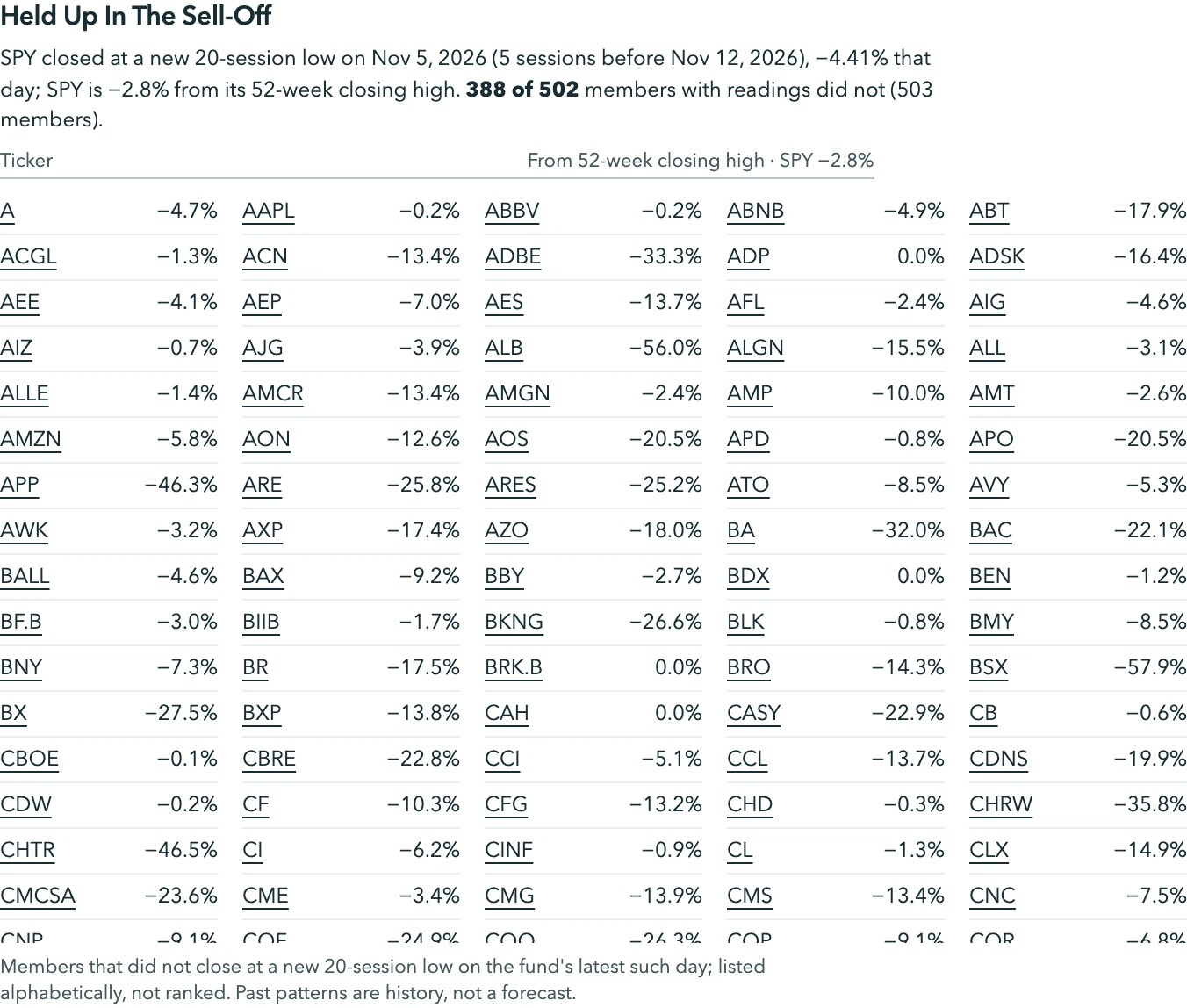
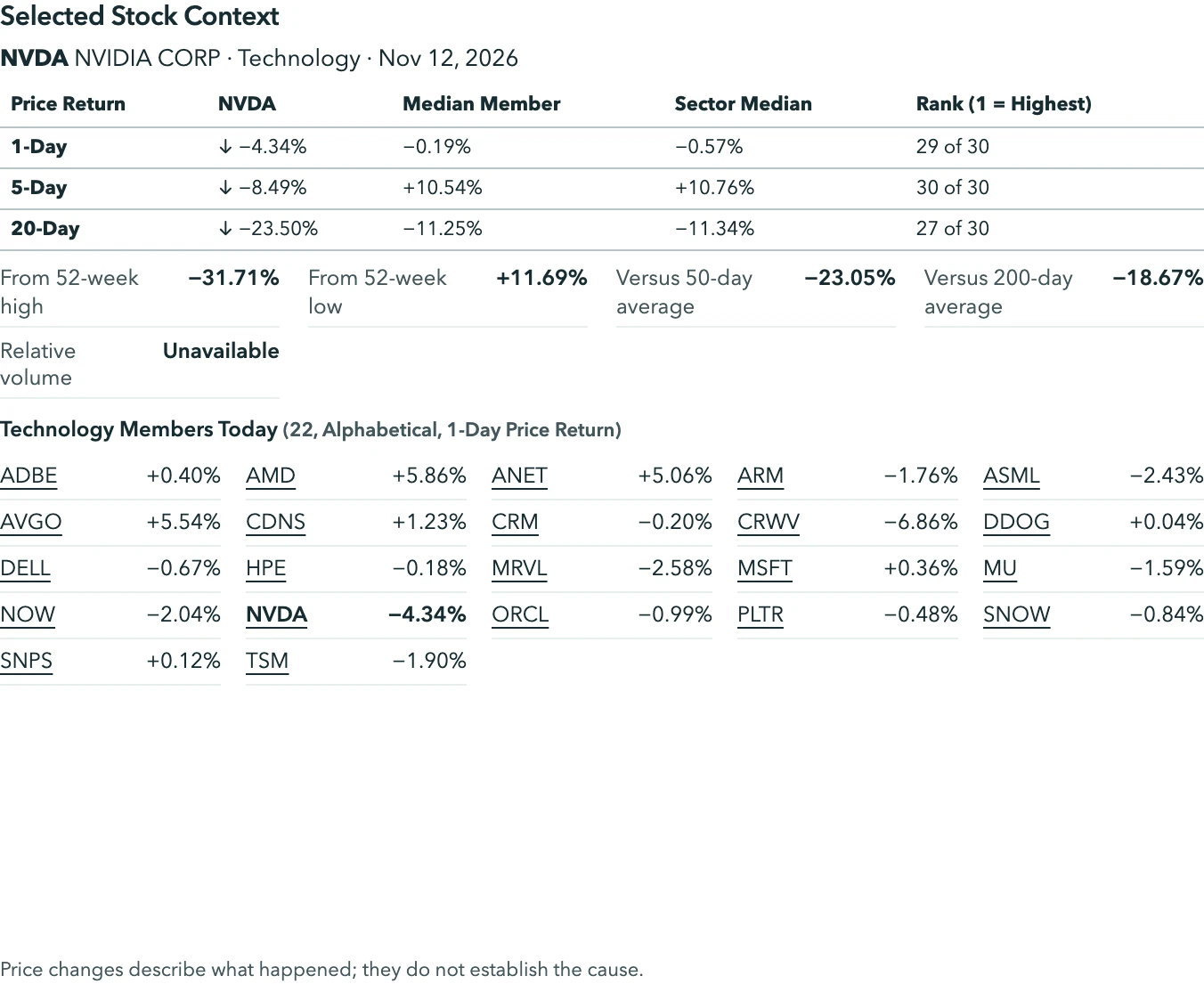
The anchor is unchanged and now 5 sessions back: 388 of 502 S&P members with readings and 59 of 101 Nasdaq-100 members did not close at a new 20-session low on November 5. On the AI 30 and crypto tabs this slot is the Selected Stock Context table, which places NVIDIA 29th of 30 on the day and Strategy last of 7.
Sectors: only Energy had a majority advancing
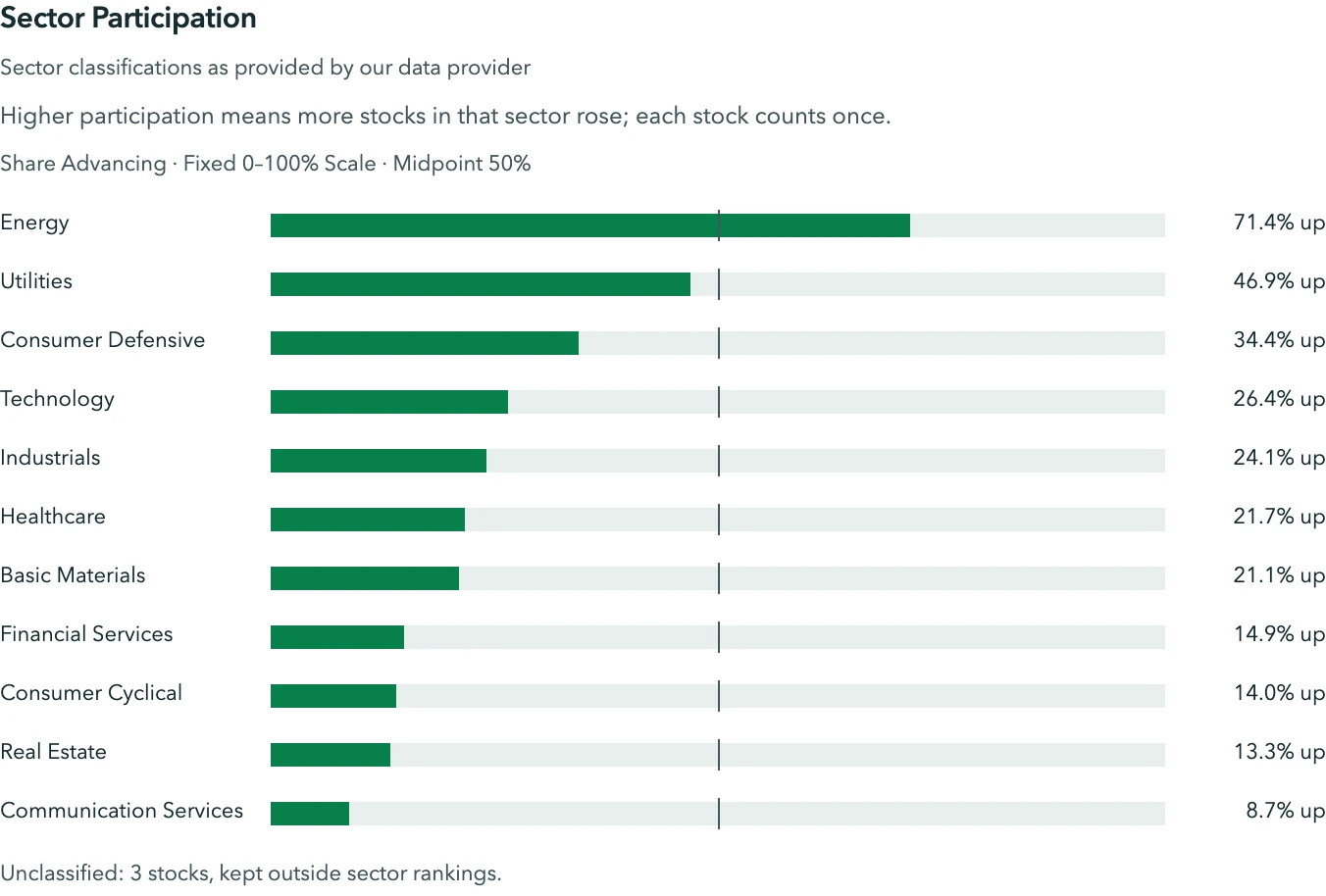
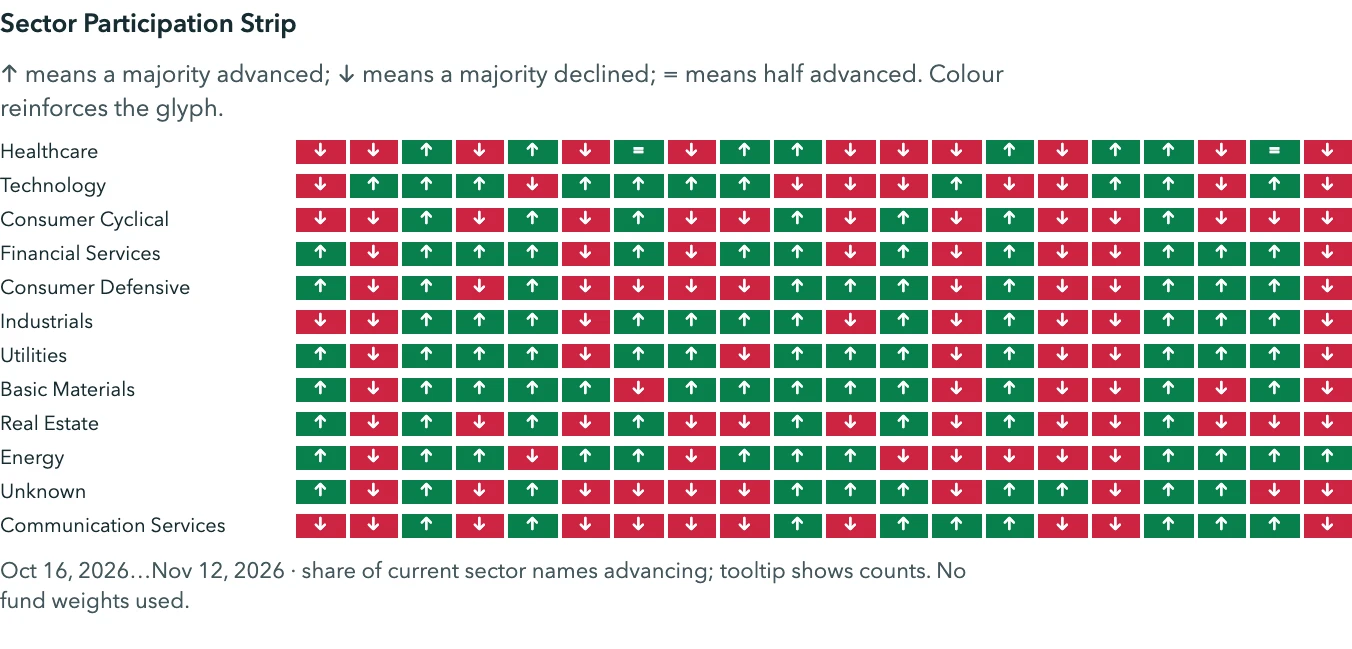
One of eleven S&P sectors had more gainers than losers: Energy, with 15 of 21 up and a median of +1.33% on a day Brent rose 3.3%. Technology had 23 of 87 members up with a median of −0.72%, so its three leaders were exceptions inside a weak group. Communication Services was weakest by both measures (2 of 23 up, median −2.30%), followed by Real Estate (13.3% advancing), Consumer Cyclical (14.0%) and Financial Services (14.9%). In the Nasdaq-100, 13 of 41 Technology members rose. On the AI 30 tab all three Utilities and Amazon rose and Technology was 8 of 22; on the crypto tab no group had a gainer. The Participation Strip marks each sector's last 20 sessions with an up arrow when a majority advanced; Thursday's column shows one for Energy alone.
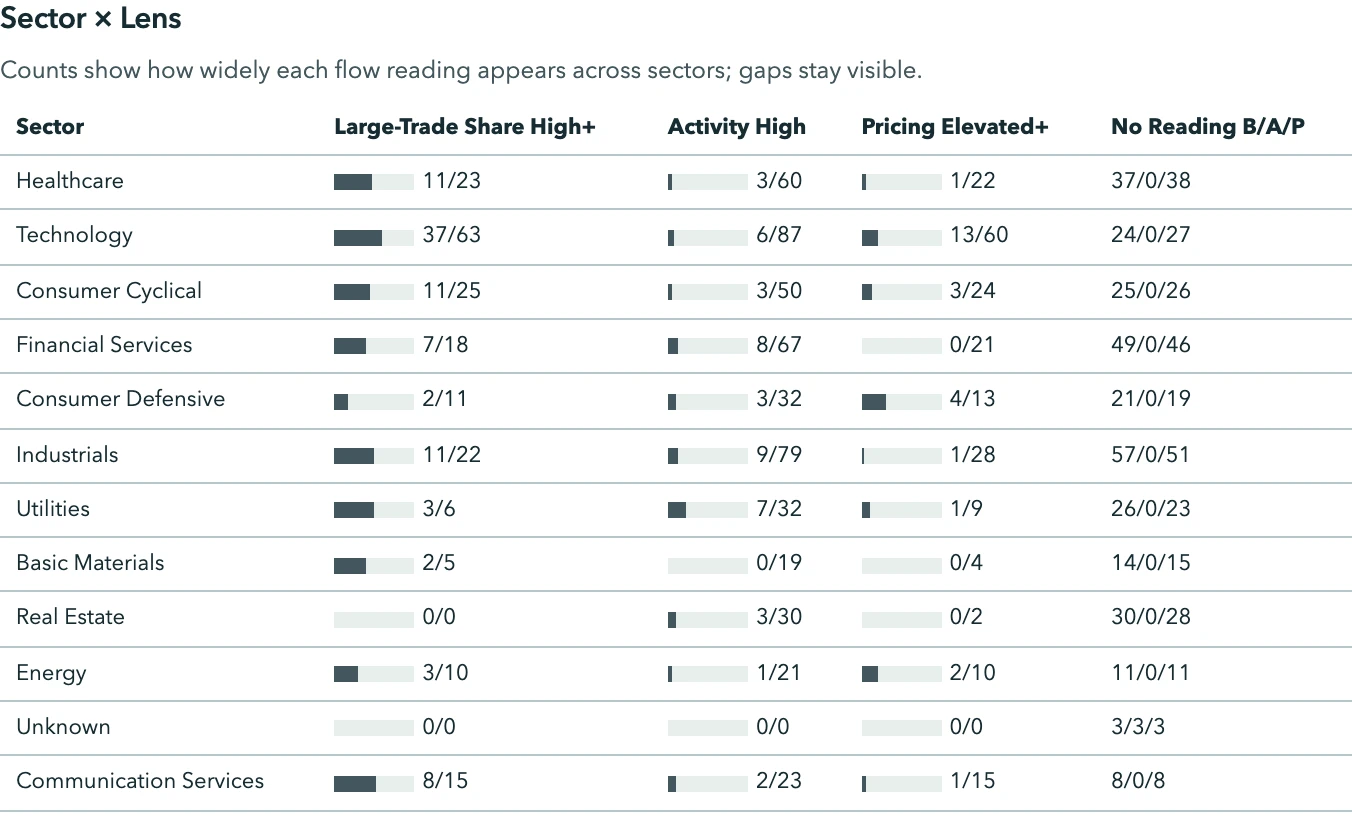
The Sector × Lens table counts how many members carry each options reading. Large-trade share compares how much of a stock's options premium came in large prints with that stock's own history; it says size, not direction. Readings of High or Very high rose to 95 of 198 S&P members with readings, from 56 of 200 on Wednesday, with 40 of 73 in the Nasdaq-100 (from 17), 17 of 30 in the AI 30 (from 10) and 1 of 2 on the crypto tab. The Full Sector Tables repeat the majorities.
Volume: quiet again, and no rebound panel
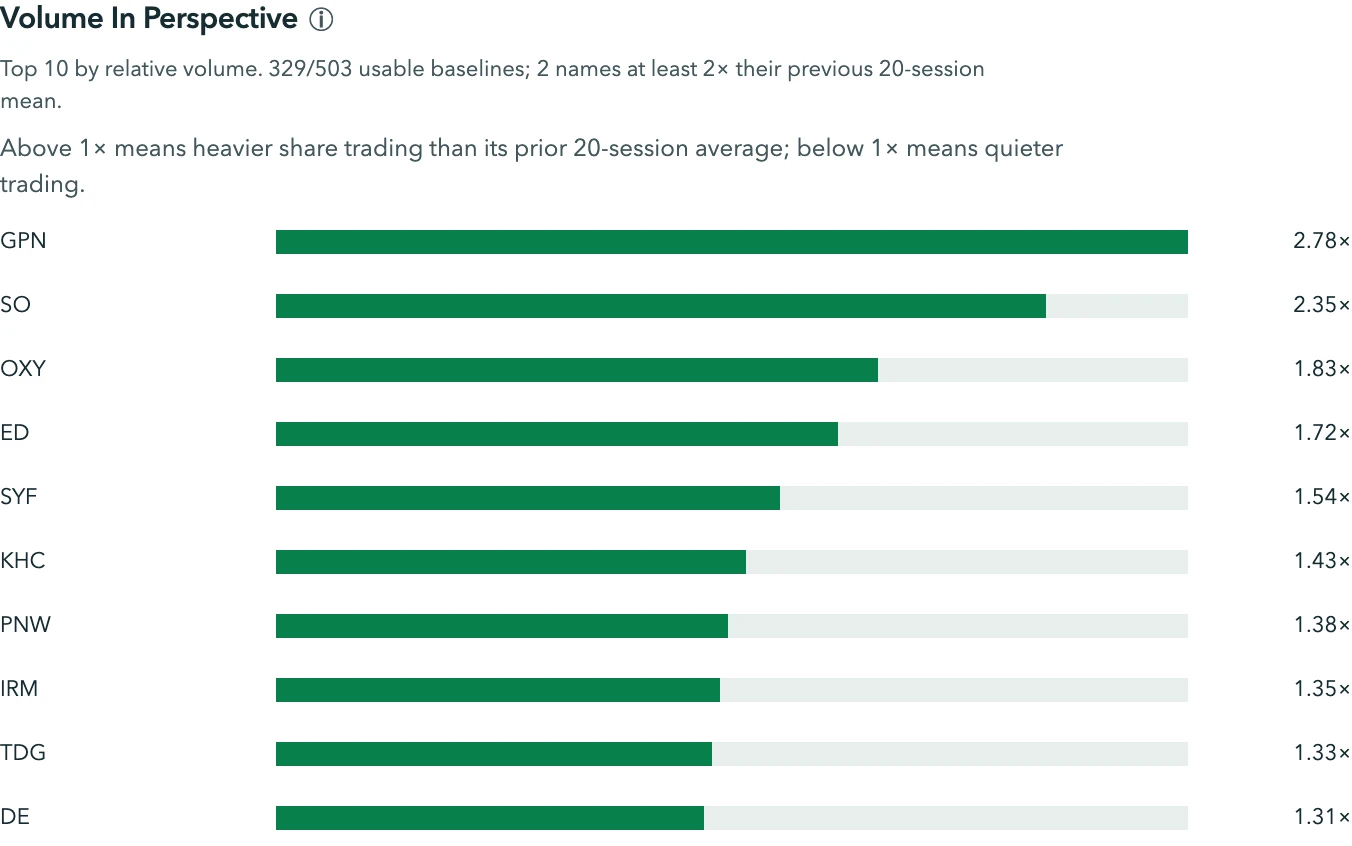
SPY's own relative volume was 0.77x and the median member's 0.68x (329 of 503 with baselines); the relative-volume histogram has two names at twice their 20-session mean or more, Global Payments and Southern. A 0.35% loss on about three-quarters of normal volume does not read, to us, as heavy selling. The "Was The Bounce Real?" panel is absent for November 12 because both funds fell. Volume remains unavailable for QQQ members; it is available for 9 of 30 AI names (median 0.65x) and 3 of 7 crypto names (median 0.75x).
Momentum: fewer overbought names, slightly more oversold
SPY's 14-day RSI eased to 48.5 from 49.9 and QQQ's to 45.4 from 46.1. S&P oversold names rose to 5 from 3 and overbought fell to 27 from 44. The Nasdaq-100 has 3 oversold and 6 overbought, the AI 30 two oversold and none overbought, and the crypto tab one oversold (the Solana staking fund, RSI 27.9). The EMA-cross filter lists 182 S&P names.
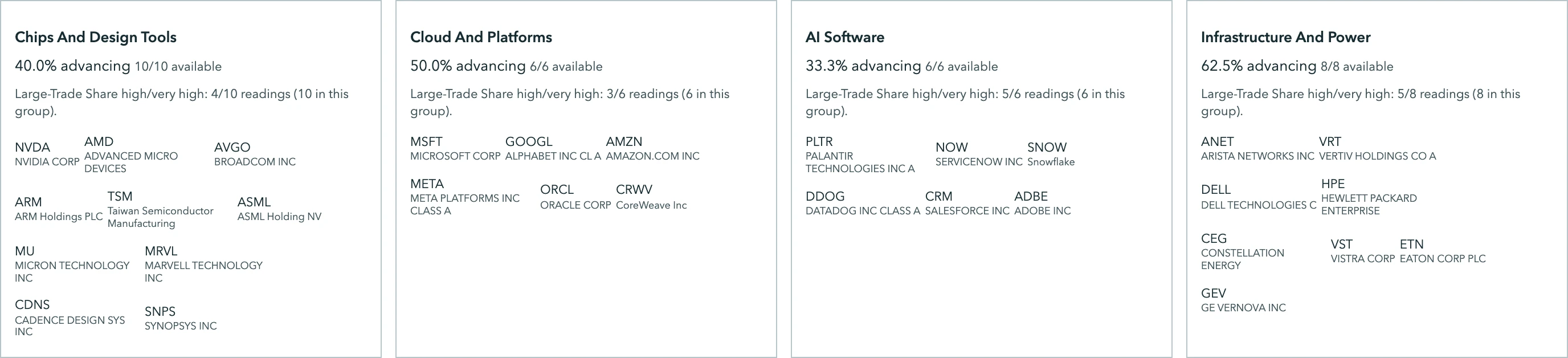
The AI Ecosystem tab: chips 40% up
Chips And Design Tools: 40.0% advancing (4 of 10), from 90.0% on Wednesday. The other three groups ran 50.0%, 33.3% and 62.5%. On the AI 30 tab the return distribution ran 14 up and 16 down around a −0.19% median, and 10 of 30 names were above their 20-day average (unchanged).
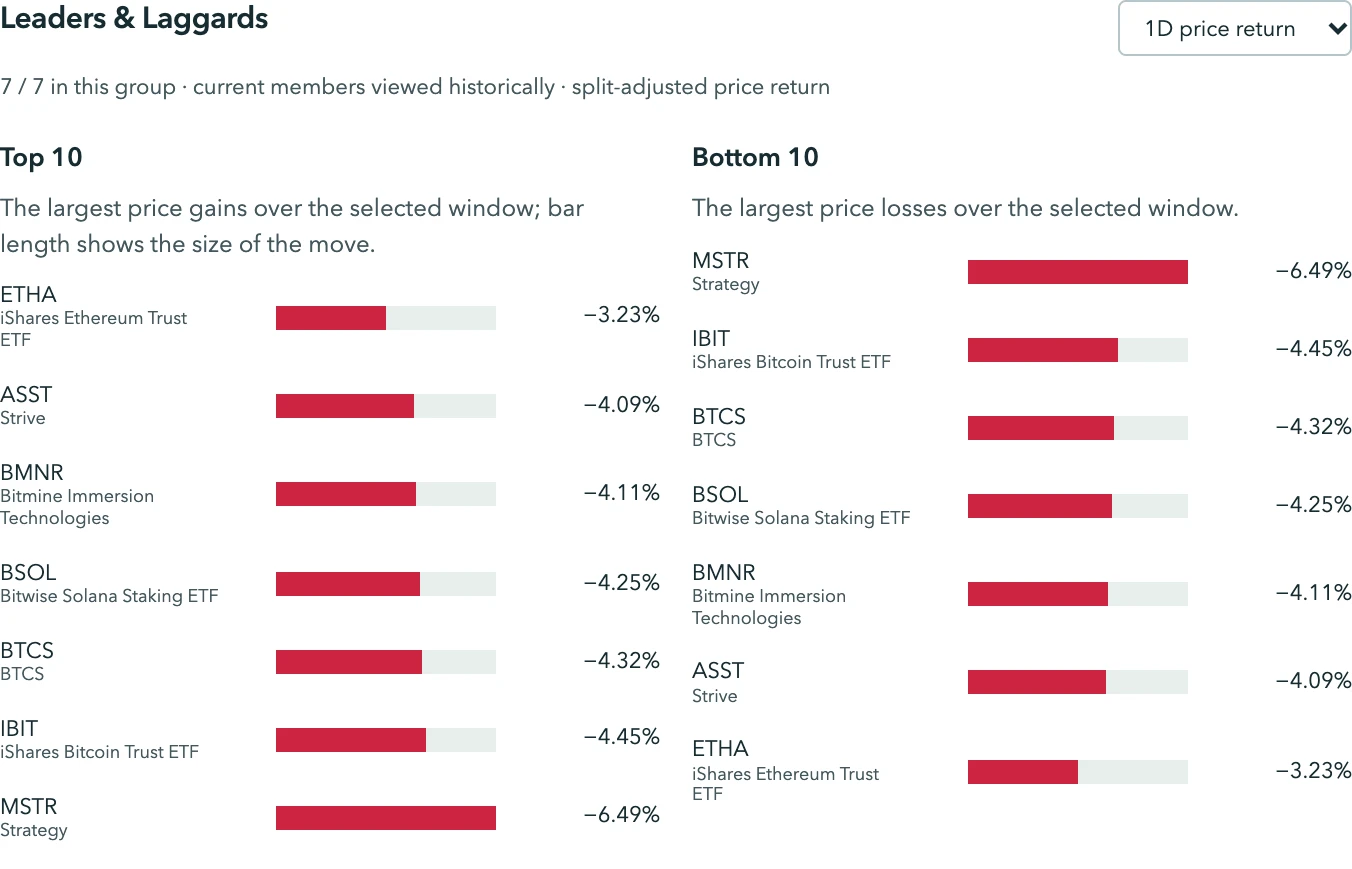
Crypto-related equities: none rose
All seven fell, from Strategy's −6.49% to the Ethereum trust's −3.23%, for a −4.25% median. None is above its 20- or 50-day average and one is above the 200-day (Strive, from two on Wednesday). Outlets reported bitcoin below $72,000 for the first time since mid-August, and Strategy's fall alongside MSCI's confirmation that it leaves three MSCI indexes at the November 30 close.

Quiet and unavailable panels, in one line
Populated: the Metric Guide, Session In One Paragraph, Today's News (10 of 31 verified stories at 7:40 p.m. CT), What Moved The Market Today (price moves only; contributions unavailable), the selected-stock charts (NVIDIA on the SPY and AI 30 tabs, Apple on QQQ, Strategy on crypto), the Lenses rail, Find A Stock and Share Previews. Unavailable: the Fund Bridge, Rotation, Big Moves event history, Flow Grid sentiment lens, Dividends and the Macro six views; the sentiment and position lenses carry no labels. The Correction Tracker page is covered above; the Economy page still reads "As of Nov 9, 2026"; the Journal index, the About page and the footer dialogs are static text.
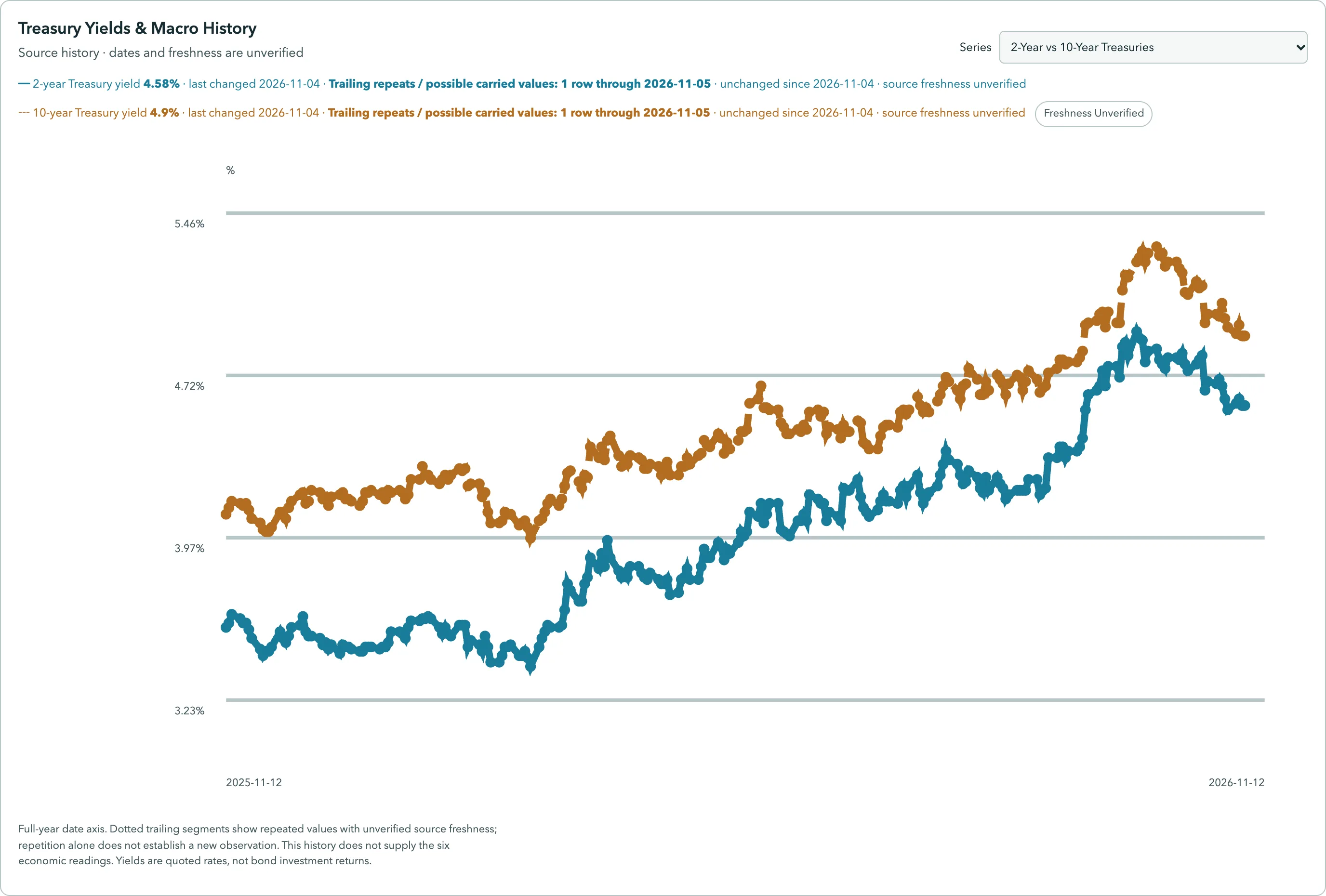
Macro panel: carried yields against a 5.10% 10-year
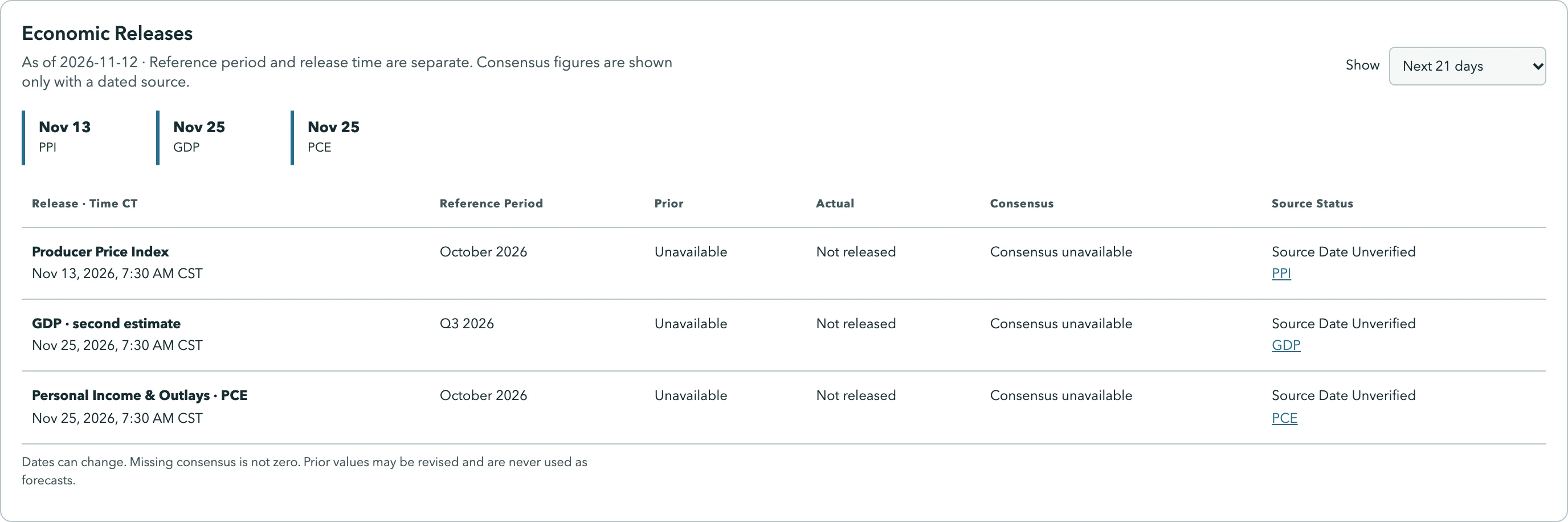
The dashboard panel is stale: it still shows a 2-year at 4.58% and a 10-year at 4.9%, last changed November 4 and marked unverified. The Treasury's par curve for November 12 reads 2-year 4.86% and 10-year 5.10%. The Economic Releases table lists Friday's PPI as "Not released" and still shows the November 10 CPI with the actual "Not captured".
Market History, Performance & DCA, Stock History
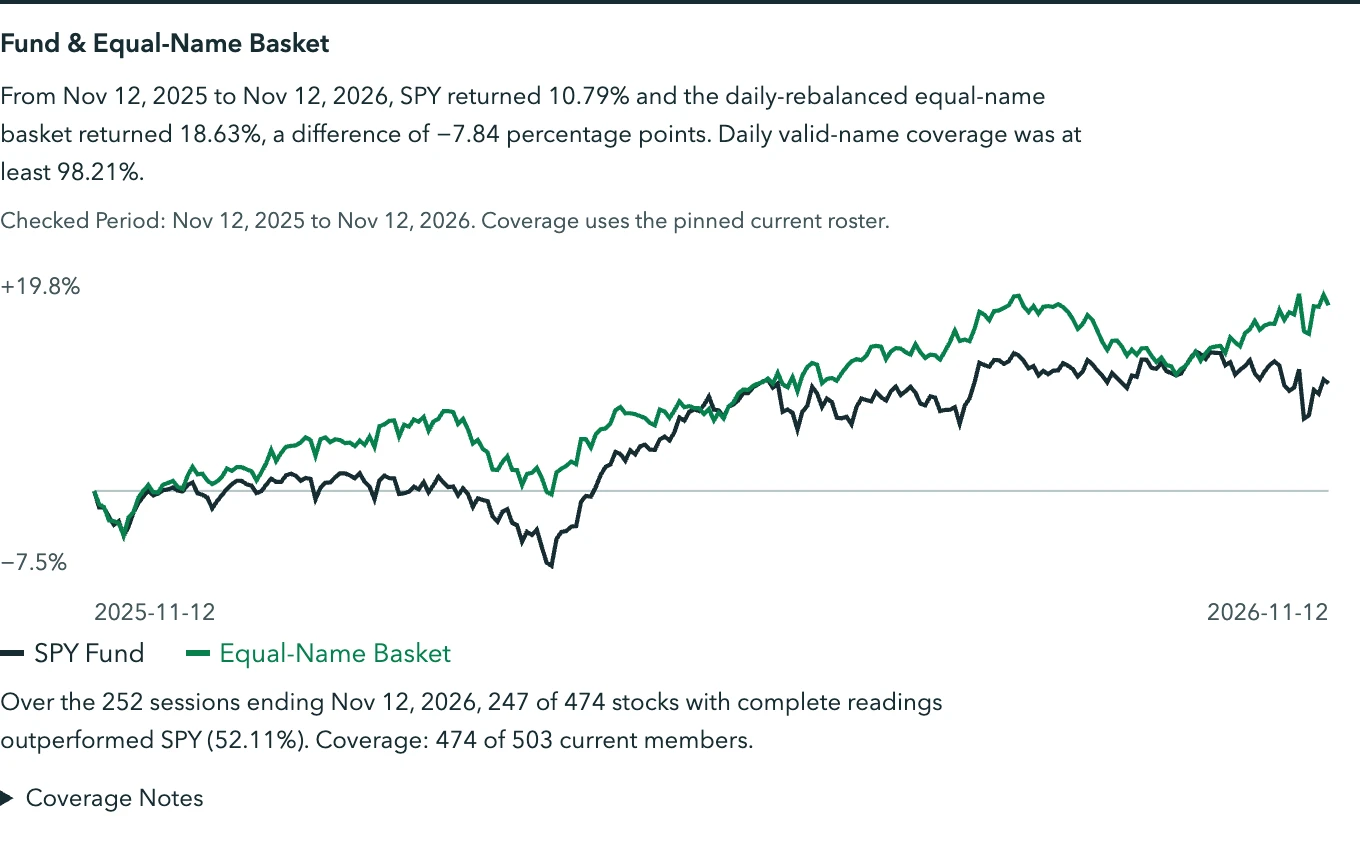
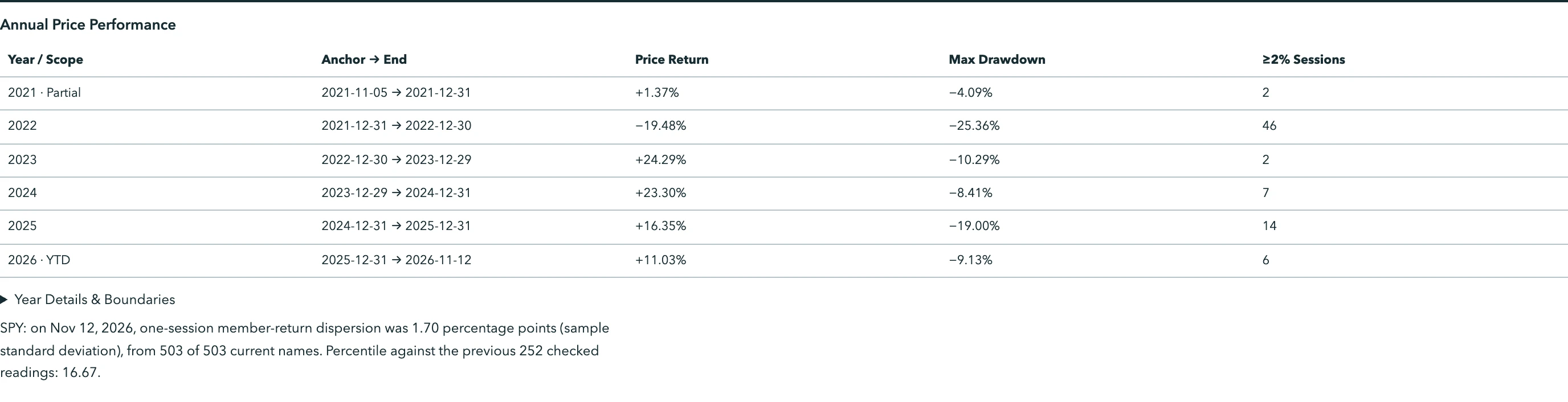
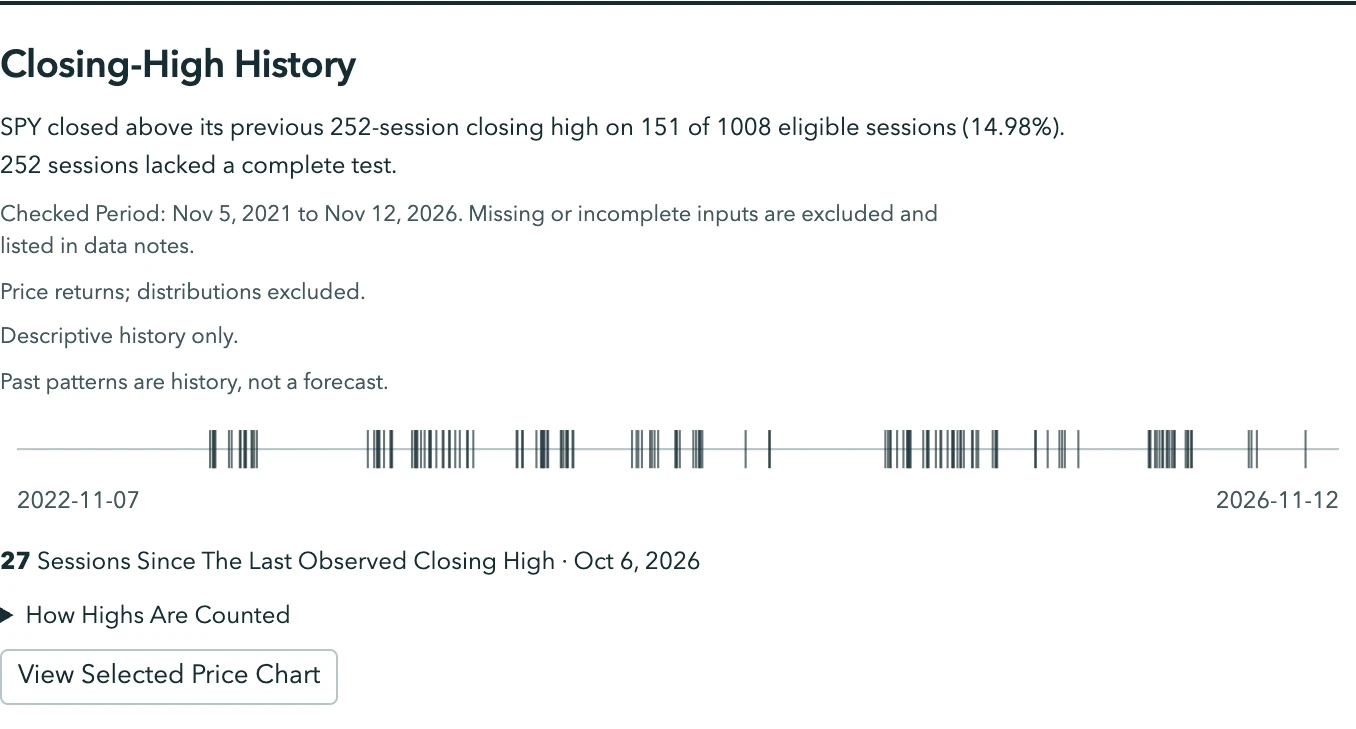
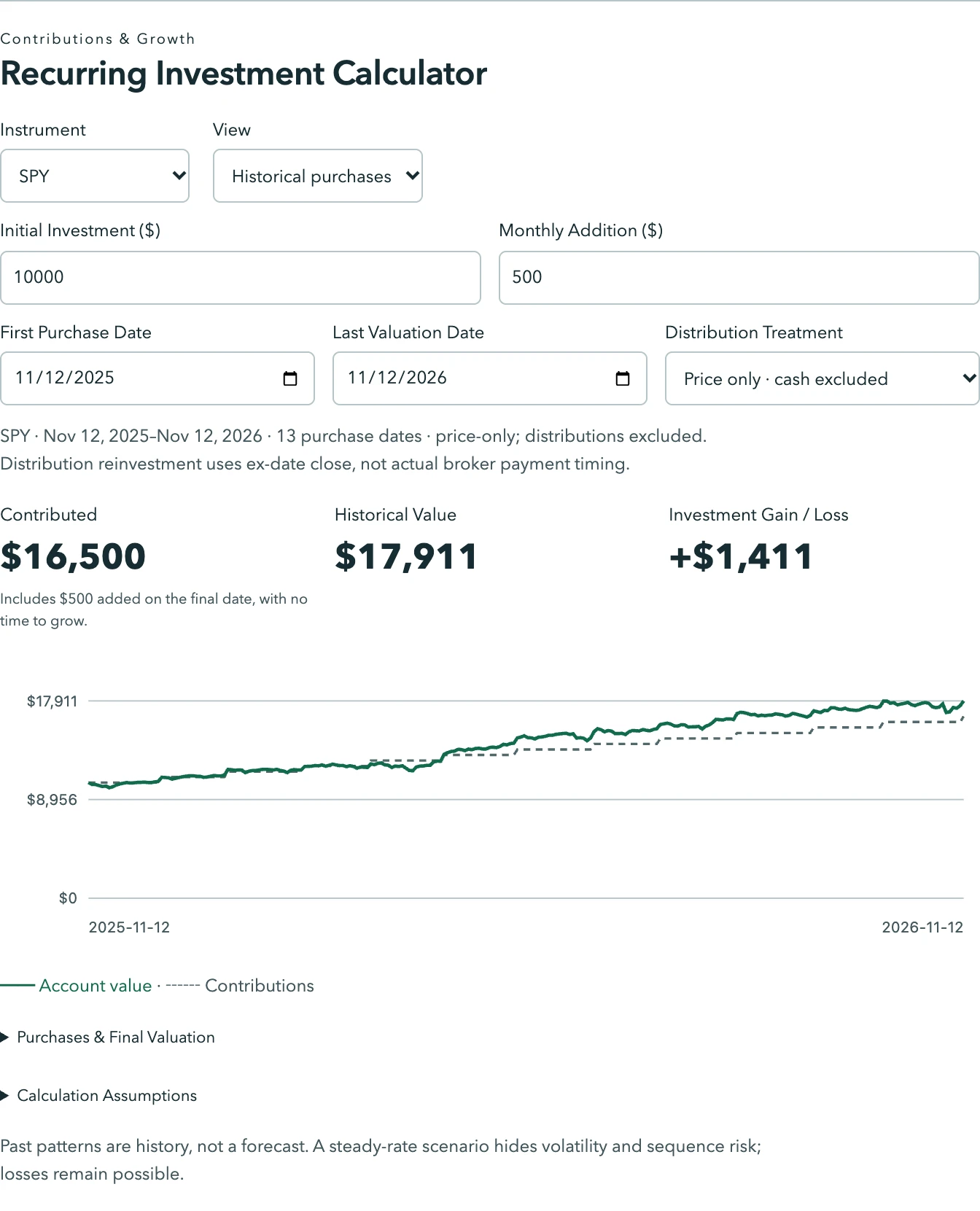
Over twelve months SPY returned 10.79% against 18.63% for an equal-name basket of its members, and QQQ 10.80% against 28.05%. For 2026 to date the funds are +11.03% and +12.02%. The Recurring Investment Calculator's default SPY case shows $16,500 contributed and $17,911 of value, price only. Stock History counts 27 sessions since SPY's last closing high on October 6; it set one on 151 of 1,008 eligible sessions (14.98%). The Performance chart is populated and the After Drawdowns card has insufficient checked data.
Flows
Figures come from the day's options tape and the dashboard's flow labels. Sides are the tape's classifications, not confirmed purchases or sales; size and side do not prove intent; flow is context, not a forecast. The tape runs from 07:30 to 16:59 ET, so none of the evening's moves are in these figures.
Market level: more premium, more of it in puts, much of it multi-leg
Options prints of $25,000 or more added up to $30.48 billion in premium on Thursday, up from $25.51 billion on Wednesday and 13% above the median of the previous 20 sessions ($27.05 billion). Puts took 59.4% of that premium, up from 42.8%; 17 of the previous 20 sessions had a lower put share. Much of it was packaging and financing: 61.2% of premium carried a multi-leg trade code, and deep in-the-money patterns that carry no direction came to $12.36 billion, against $5.47 billion on Wednesday.
In SPY, big-print call premium of $334.7 million topped put premium of $283.9 million, but with multi-leg and deep in-the-money trades set aside, single-leg put premium ($206.3 million) exceeded single-leg call premium ($140.3 million). QQQ's big-print put premium of $912.9 million was more than double its call premium of $434.3 million, yet $520.4 million of those puts were deep in-the-money financing-type trades. SPY's large-trade-share label fell from Very high to Normal and QQQ's rose from Normal to High. The activity lens rated 262 of 528 names Low, from 247.
Sectors: Technology busiest; three dividend artefacts
Technology option volume ran 1.29 times its 30-day average, the most of any sector, with put volume at 1.39 times and call volume at 1.22 times. Across all 184 Energy stocks on the tape, premium more than doubled from Wednesday (+139.1%; +37.3% without Shell), but among the dashboard's 21 Energy names it fell 15.8%. Deep in-the-money calls traded the session before a stated dividend date, about $255.3 million in Starbucks, $153.4 million in Shell and $95.9 million in Eli Lilly, fit the dividend-arbitrage pattern, which carries no direction.
Single names: NVIDIA near even on nearly ten times its usual premium
NVDA's big-print premium of $3.74 billion was 3.4 times Wednesday's and 9.8 times its 20-session median. Call volume ran 2.7 times and put volume 3.2 times their 30-day averages, and premium classified as bullish ($2.64 billion) and as bearish ($2.62 billion) was nearly even. AMD rose 5.9% with call volume at 1.6 times its 30-day average. Nebius fell on the day it reported, so its options activity mixes the earnings reaction with the Nvidia news; puts made up $174.4 million of its $239.2 million in big-print premium. Across the AI 30, put volume rose to 0.77 times call volume from 0.60, with put volume at 1.54 times its 30-day average on a median move of −0.19%.
Large and unusual prints: structures first
The day's largest packages were S&P 500 index box spreads, led by a 3,000-lot June 2027 7000/8000 box at 12:50 p.m. worth about $549.1 million gross; these are financing trades with no market direction. The largest NVDA trades were call spreads coded as single multi-leg orders, among them 34,998 March 2027 170/185 calls at 9:52 a.m.; they are structures, not one-way positions. The largest single-leg NVDA order was a 100,000-contract January 2027 $140 put block worth about $50.5 million, carrying a late-report code and no side classification. AMD's largest package was a 12,500-contract February 2027 650/750 call spread worth about $105.5 million gross at 11:22 a.m.
Tying it in
The put share of premium rose on the day 377 S&P members fell, and Technology, where only 23 of 87 members advanced, had the busiest option volume against its own average. The headline put figures need care: SMH's big-print put premium rose to $396.8 million from $117.3 million, but $308.0 million of it was deep in-the-money financing-type puts. In NVIDIA the classified premium was balanced and the largest trades were spreads, in a stock that fell 13% at the open and recovered two-thirds of it by the close. Our reading: more activity and more put premium than Wednesday, but less one-way than the put share suggests.
Economy
Released or settled on Thursday, November 12:
- Treasury par yields (Treasury Department, November 12): 2-year 4.86%, 5-year 4.95%, 10-year 5.10%, 30-year 5.43%. The previous curve is November 10's (4.73%, 4.81%, 4.98%, 5.35%); the cash market was closed on Wednesday.
- Existing-home sales, October: down 5.5% from September to a 3.75 million annual rate, the slowest since August 2010, as reported by NPR and AP.
- Oil: Brent settled up 3.3% at $95.82 and WTI up 2.55% at $88.74 (CNBC).
- Fed pricing: a December rate increase is reported as fully priced (CNBC).
Improved since the previous release: nothing in Thursday's readings.
Deteriorated: the 2-year par yield rose 0.13 percentage points and the 10-year 0.12 from November 10, and the 10-year's 5.10% is its first par close above 5% this month. Existing-home sales fell 5.5%. Oil rose.
What it means for SPY and QQQ (our view): bull evidence: the index met a 12-basis-point rise in the 10-year since November 10 and the resignation of its largest company's CEO, and lost a third of a percent; new highs outnumbered new lows 18 to 2. Bear evidence: the 10-year is above the 5.00% line we named on Wednesday for after PPI, and it got there before PPI; and the 2-year at 4.86% is above the 4.73% ceiling named the same day. We read the rate path as the main risk to both funds now that the Nvidia event has a known shape.
Next release that could change this: October PPI, Friday, November 13, 08:30 ET (Bureau of Labor Statistics); then October retail sales, Tuesday, November 17, 08:30 ET (Census Bureau); FOMC minutes, Wednesday, November 18, 14:00 ET; GDP and PCE, Wednesday, November 25, 08:30 ET (Bureau of Economic Analysis).
Outlook
Scenarios with conditions, not forecasts; the weights are our subjective leanings and sum to 100. They cover three sessions, Friday, November 13 through Tuesday, November 17, ending before Nvidia's results that evening, so exactly one will have happened; evaluate bear first, then bull, else base. The levels are Thursday's own: the session that priced the resignation set a low and a high for each fund, and a close outside that range would tell us something new.
How the day's main items move the weights. The resignation replaces an open board decision with a filed fact, the main reason the bear case falls to 30% from 40%. The gains in AMD and Broadcom show the index held without NVIDIA for a session, which lifts the bull case to 25% from 15%. Nebius argues against lifting it further: AI names that spend ahead of revenue stay on the laggard list. Cerebras's after-hours gain is one more non-Nvidia chip supplier rising, outside our lists. The evening tape (QQQ +0.40%, SPY +0.26%, futures higher as reported) puts no price beyond a new trigger. Friday's PPI and Fed speakers, with the 10-year already at 5.10%, are why the bear case stays as high as 30%. Our lean is modestly bullish on SPY and QQQ: the bull and base cases carry 70% of our weight, the base case is a hold above QQQ's 200-day average, and the bear case has a named trigger.
Bear — "Thursday's low gives way" (about 30%, from 40%).
- Trigger: any QQQ close below $679.83, Thursday's low, or any SPY close below $741.95, from Friday through Tuesday.
- Path: QQQ back under its 200-day average at $681.99 and then Thursday's low, toward the November 10 close of $674.76, with $662.64 beneath. SPY through Thursday's low of $753.67 toward $741.95. The accompanying signs would be a 10-year par yield above 5.10% after PPI and NVIDIA closing below $156.20.
- Leaders and laggards: relative leaders would be Energy (15 of 21 up on Thursday), Utilities and Thursday's 18 new-high names. Laggards: NVIDIA, Nebius, CoreWeave, Super Micro, and Real Estate, Financial Services and Consumer Cyclical.
- Window: any close from Friday, November 13 to Tuesday, November 17.
- Invalidation: no such close through Tuesday.
Bull — "Thursday's highs are cleared" (about 25%, from 15%).
- Trigger: no bear trigger, and on Tuesday, November 17 SPY closes above $763.04 and QQQ above $694.56, Thursday's highs (rises of 0.78% and 0.93% from Thursday's closes).
- Path: SPY through its 20-day average at $759.47 and Thursday's high toward its 50-day at $764.80. QQQ through $690.38 and $694.56 toward its 20-day at $696.94. The conditions would be a PPI at or under the reported consensus and yields no higher than Thursday's.
- Leaders and laggards: AMD and Broadcom keep leading, as does Arista, joined by a broader majority than Thursday's 24.7%. NVIDIA can lag; the case needs the AI 30 count at 8 or more, not NVIDIA above $168.89.
- Window: Tuesday's close.
- Invalidation: a bear trigger at any close, or either fund at or below its level on Tuesday.
Base — "inside Thursday's range" (about 45%, unchanged).
- Trigger: no bear trigger, and Tuesday's closes do not clear both bull levels.
- Path: QQQ holds between $679.83 and $694.56, around its 200-day average of $681.99 and its after-hours $690.90. SPY holds between $753.67 and $763.04, around its 21-day exponential average of $758.46. NVIDIA trades between Thursday's $148.80 low and $168.89 into its report.
- Leaders and laggards: the largest weights outside NVIDIA, AMD and Broadcom lead; the median stock lags the funds as it did on Thursday; the AI 30 count stays near 8.
- Window: through Tuesday's close.
- Invalidation: a bear trigger, or Tuesday closes above both $763.04 and $694.56.
Before turning constructive on concentrated AI we would want: NVIDIA closing back above $168.89; the AI 30 count above its 50-day holding at 8 and rising toward 10; QQQ holding $681.99 on closes; Tuesday's Nvidia report confirming the roadmap and guidance under interim CEO Colette Kress; and a 2-year par yield no higher than 4.86% after PPI.
Warning signs that would strengthen the case for caution: a QQQ close below $681.99, then $679.83; a SPY close below $753.67, then $741.95; NVIDIA closing below $156.20; S&P members above the 200-day under 55% (Thursday: 61.8%); new lows exceeding new highs (18 to 2); a second session with under a third of S&P members advancing; the AI 30 count back to 7 or fewer; a 10-year par yield above 5.10% after PPI.
Dip, wait, or trim? On November's earlier down days SPY fell more than its median stock; on Thursday the index held while the median stock fell. The Nvidia event now has a known shape: an interim CEO, a kept results date, and a stock that closed 11.7% above its low of the day. That is why the lean moves up from neutral. It goes no further because an index held up by a few large names over a falling majority is narrow. Dip-buyers would want to see QQQ hold $679.83, breadth recover from 24.7%, and a PPI that does not push the 10-year further above 5.10%. The case for trimming concentrated AI would rest on NVIDIA closing below $156.20 or a QQQ close below $679.83, and the case for trimming broad exposure on a SPY close below $741.95. Net: the lean is to the upside on the index through Tuesday, with the weight of proof on breadth and on Friday's yields.
Key dates beyond the releases listed under Economy and the requested testimony above (times ET; dates can change; † = unverified): Tue Nov 17, about 16:20 — NVIDIA results, call 17:00 (company notice). Wed Nov 18 — Anthropic IPO pricing, as reported by CNBC, not official†. Fri Dec 4† — jobs report. Wed Dec 9, 14:00 — FOMC decision. Thu Dec 10† — CPI.
Final summary
- QQQ's $679.83 and SPY's $763.04. Thursday's low in QQQ sits just under its 200-day average of $681.99 and is the bear trigger; Thursday's highs, $763.04 and $694.56, are the bull levels for Tuesday's close.
- Breadth and yields on Friday. PPI at 08:30 ET meets a 10-year at 5.10% and a market in which 24.7% of S&P stocks rose. A broader advance with yields no higher would support the lean; a second narrow session with a higher 10-year would argue against it.
- NVIDIA into Tuesday. $168.89 is the close to reclaim and $156.20 the one to hold. Tuesday's report is the first under interim CEO Colette Kress; the allegations and the requested testimony remain open.
Correction, Nov 21, 2026: The Treasury yields chart in this post shows data through Nov 5, not through the date in its caption.