
Executive summary
Monday answered the question we left open on Friday. SPY rose 2.37% to $752.69 and QQQ 3.54% to $679.35, and this time the majority came along: 84.1% of S&P 500 members advanced, the median stock gained 2.03%, and 63.0% of members were above their 200-day average, from 55.8%. Our 30-name AI basket had 28 of 30 up with a median gain of 5.46%, while NVIDIA fell 4.27% to $178.67 alongside reports that its board opened an internal investigation into an alleged foreign-intelligence effort targeting its chief executive — an allegation, not a finding. A wire wrap called it the S&P 500's best day since April; Brent fell 5.85%, the 2-year Treasury yield rose to 4.56% and futures implied about an 84% chance of a December hike. Our view: the broad market has met the breadth test we set, moving us from wait-and-see toward constructive on broad exposure; concentrated AI exposure has bounced but not repaired (16.67% of AI 30 names above their 50-day). Tuesday's 08:30 ET CPI is the test; a core print of 0.3% or more would, in our view, put the rally on probation.
Scorecard (look-back on the November 6 post)
Each call is quoted as written on Friday; the scenario window runs through Friday, November 13, so most items are interim.
- Stance: "Our stance into next week is wait-and-see — not yet a confirmed dip, not yet a broken market — with CPI on Tuesday and NVIDIA on the 17th as the tests." — Open; the confirmation we asked for arrived the next session, with 423 of 503 S&P members rising.
- Call 1, SPY holds its 200-day on Monday: "SPY does not close below 730.38 on 2026-11-09" — Hit: $752.69, 22.31 points above.
- Call 2, SPY holds its 200-day all week: "No SPY close below 730.38 on any session 2026-11-09 to 2026-11-13" — Open, on track (3.05% above after one of five sessions).
- Call 3, QQQ holds Thursday's low all week: "No QQQ close below 647.05 on any session 2026-11-09 to 2026-11-13" — Open, on track ($679.35, 4.99% above; intraday low $662.02).
- Call 4, the first up day stays narrow: "The first SPY up day (r1 > 0) in 2026-11-09 to 2026-11-13 is NOT broad (the 'bounce stays narrow' view)" (r1 is the one-day price return) — Miss: 84.1% advancing, median +2.03%.
- Call 5, most S&P stocks stay above their 200-day: "SPY share above SMA200 stays at or above 50% on every session 2026-11-09 to 2026-11-13" (SMA200 is the 200-day average) — Open, on track: 63.0% (312 of 495).
- Call 6, the base case plays out: "The highest-weighted scenario (base, 0.45) is the one realized by the 2026-11-13 close" — Open. Bear, "SPY closes below its 200-day ($730.38) on any day, or QQQ closes below Thursday's $647.05.", is not triggered. Bull, "Neither bear trigger fires; SPY closes Friday, November 13 above its November 6 high of $742.21 and QQQ above its November 6 high of $664.52; and at least one session in between has more than 60% of S&P members advancing with a positive median stock", is provisionally met (SPY 10.48 points above $742.21, QQQ 14.83 above $664.52), subject to Friday's closes. Base, "Everything else: SPY holds its 200-day but the bull conditions are not all met; oversold bounces alternate with selling, sector leadership flips daily, dispersion stays high, and the market waits for CPI, PPI and NVIDIA.", needs Friday's closes to slip back. Interim: drifting toward bull, which we weighted at 25%.
- Rebound requirements: "a broad up day (more than 60% of S&P members advancing with a positive median); SPY above its 200-day all week and no new QQQ closing low; fund RSI back into the 40s; CPI passing without a jump in hike odds; and NVIDIA on November 17 confirming that supplier demand is intact." — Broad day hit; 200-day/no new low open, on track; RSI hit (SPY 45.8, QQQ 41.4); CPI open (reported December odds rose to about 84% from 78% before the print); NVIDIA open.
- Warning signs: "a SPY close below $730.38; fewer than 50% of S&P stocks above their 200-day; a QQQ close below $647.05; the 10-year back above 5%." — None triggered: $752.69; 63.0%; $679.35; Treasury par 10-year 4.88%.
Honest reading: the levels held and the test was right, but we weighted the narrow-bounce path too heavily.
Section by section
Pulse: the majority showed up
SPY: +2.37%, 84.1% of 503 members advancing, 69% / 69% / 63% above the 20-, 50- and 200-day averages, 11 oversold against 37 overbought. QQQ: +3.54%, 85.1% advancing, 50% / 53% / 52%, 6 oversold against 4 overbought. AI 30: 93.3% advancing but only 20% / 17% / 40% above its averages; crypto-related 28.6% and 0% / 0% / 29%. Friday's green index over a red majority became a green index with a green majority.


The session: a gap that held — and why the market moved
SPY opened at $741.95, 0.91% above Friday's close, reached $755.42 and closed at $752.69; QQQ opened at $662.64 (+1.00%), reached $682.48 and closed at $679.35. By our arithmetic SPY has recovered 58.2% of Thursday's 33.81-point drop and QQQ 71.9% of its 44.90-point drop. Reuters reported the Philadelphia semiconductor index up more than 6% after losing more than 12% the prior week, Brent down $5.75 at $92.57 (attributed by Reuters to President Trump saying fresh attacks on Iran were highly unlikely while talks progressed), and Morgan Stanley and UBS calling the AI sell-off overdone — all coincident with the rally; we do not claim which caused it.
How far from the high, and how deep is the correction?
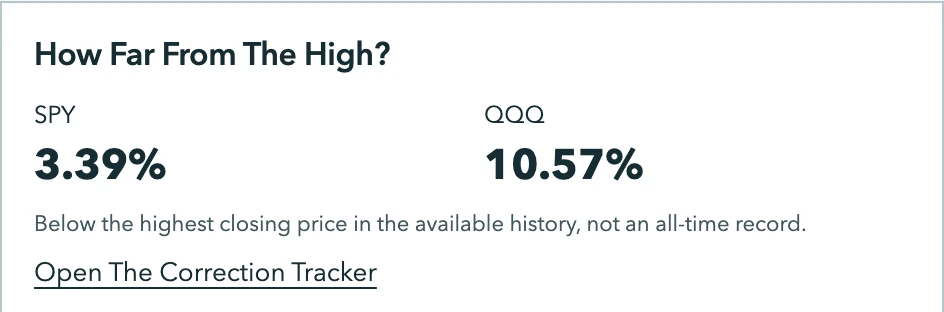
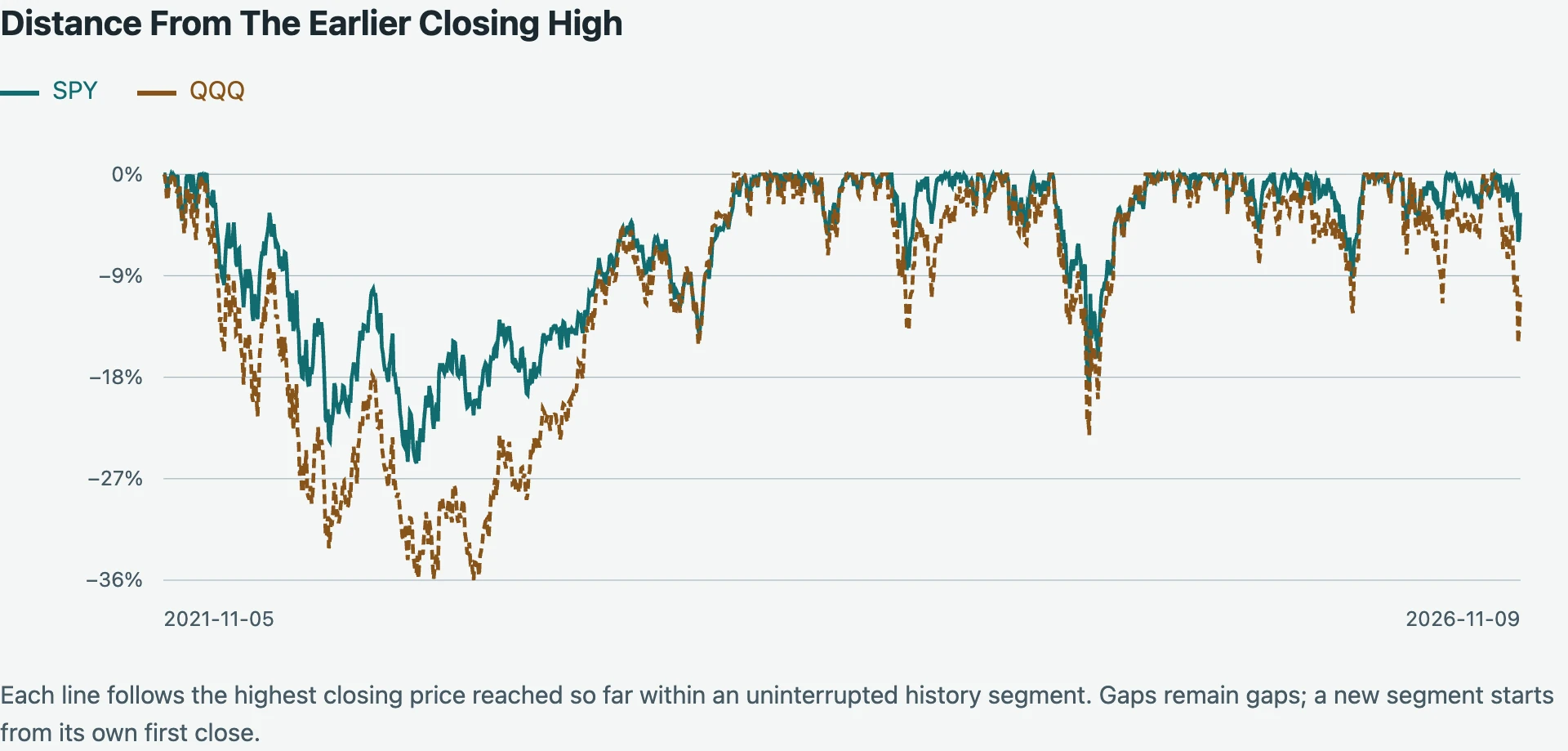
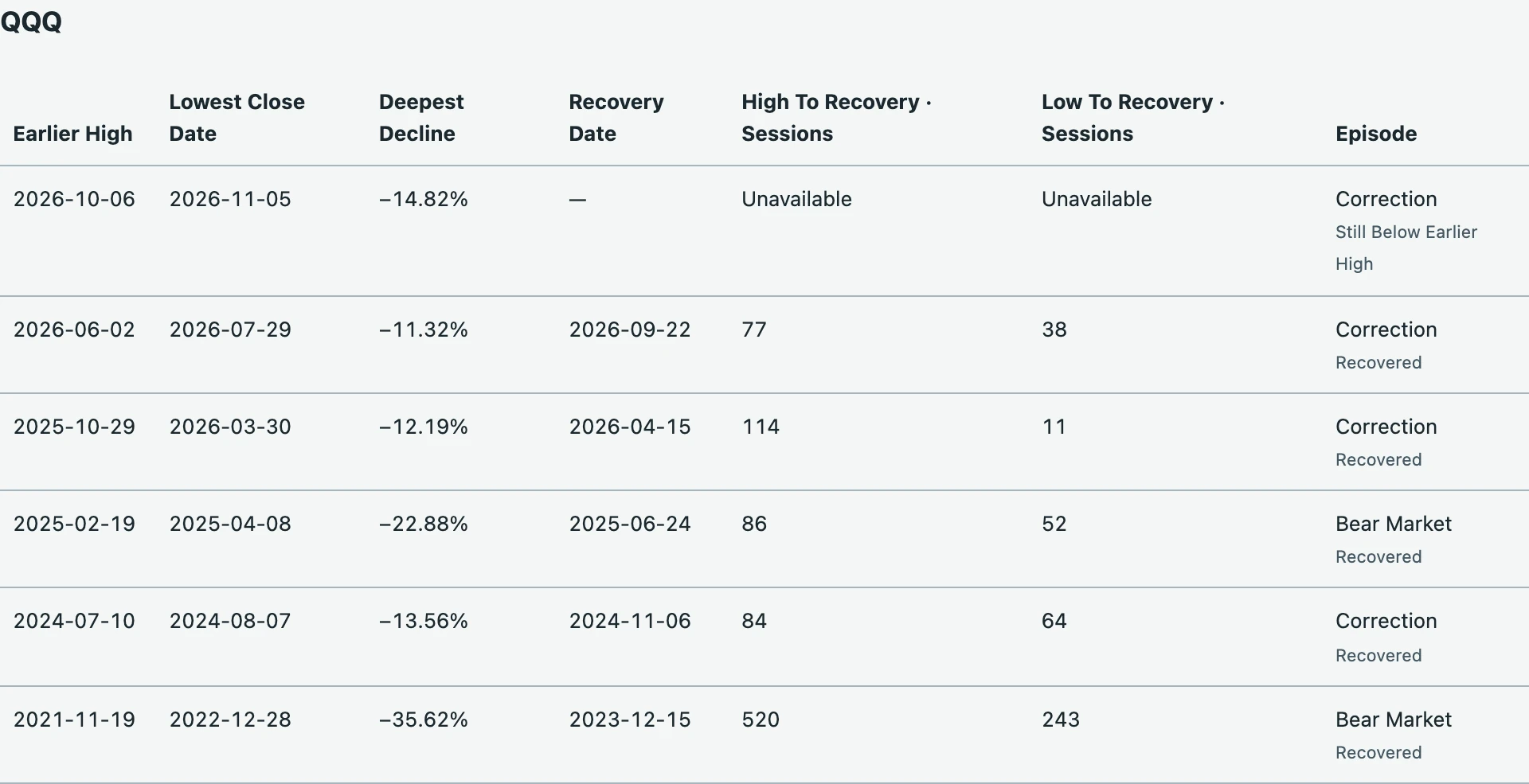
SPY is 3.39% and QQQ 10.57% below their closing highs, both set October 6, 24 sessions ago. The Correction Tracker puts QQQ's open episode at a deepest decline of 14.82% on November 5, a correction; SPY has no open decline of 10% or more. QQQ's completed corrections since mid-2024 bottomed between -11.32% and -13.56%, with 11 to 64 sessions from low to recovery, and a 2025 bear market reached -22.88% (52 sessions). History is not a forecast, but a 14.82% drawdown sits between those corrections and the 2025 bear market.
AI 30 Health: the AI sell-off, measured
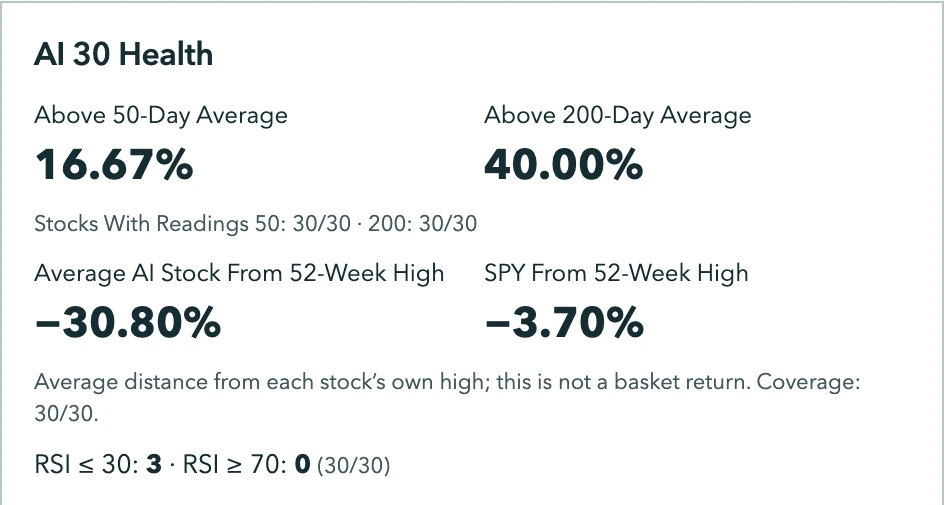
The average AI 30 stock is 30.80% below its own 52-week high, against 3.70% for SPY; 16.67% of names (5 of 30) are above their 50-day and 40.00% (12 of 30) above their 200-day; 3 are oversold. Friday's reads were 13.33%, 30.0%, 34.00% below and 5 oversold, so Monday repaired something, but 24 of 30 names still sit below their 20-day. Reuters also reported lenders growing wary of AI debt — caution, not defaults. In our view this is a bounce inside a downtrend, not a trend change.
Equal stocks versus fund weight
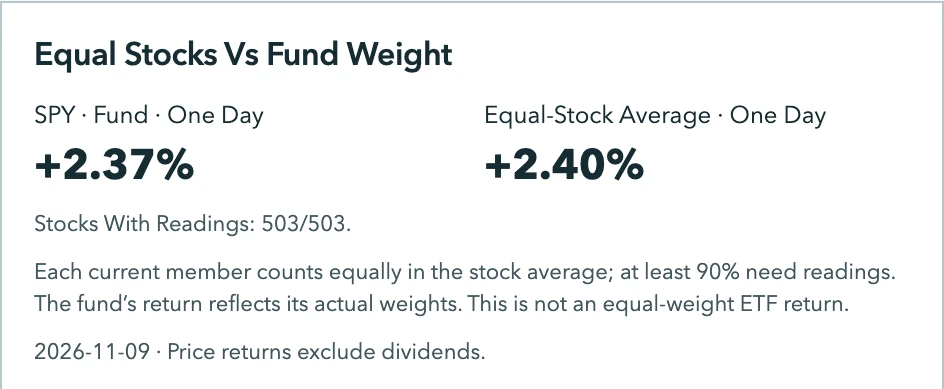
SPY's +2.37% compares with an equal-stock average of +2.40% and a median of +2.03%; QQQ's +3.54% with +3.46% and +2.56%. On Friday the funds had beaten their averages (SPY +0.31% against -0.25%; QQQ +1.40% against +0.74%). On these readings, in our view, Monday was not a mega-cap effect.
Distribution and breadth history: the 200-day line moved the right way
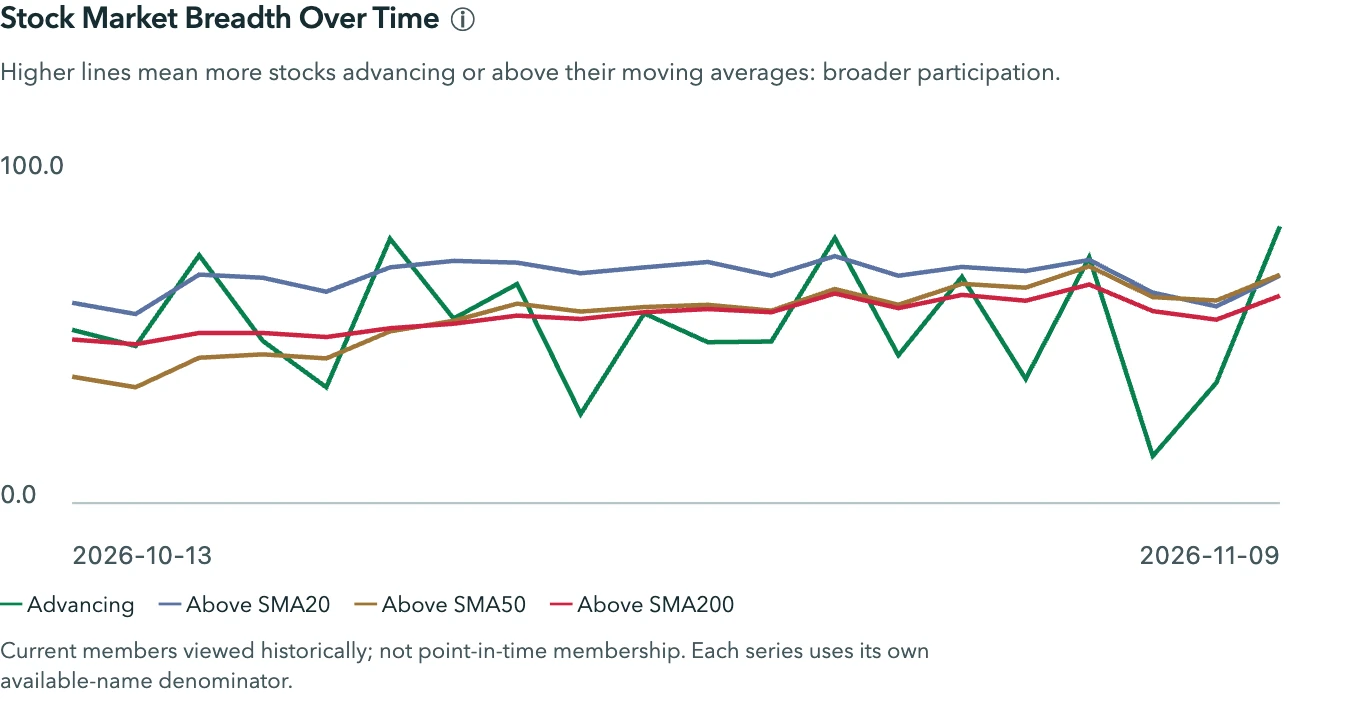
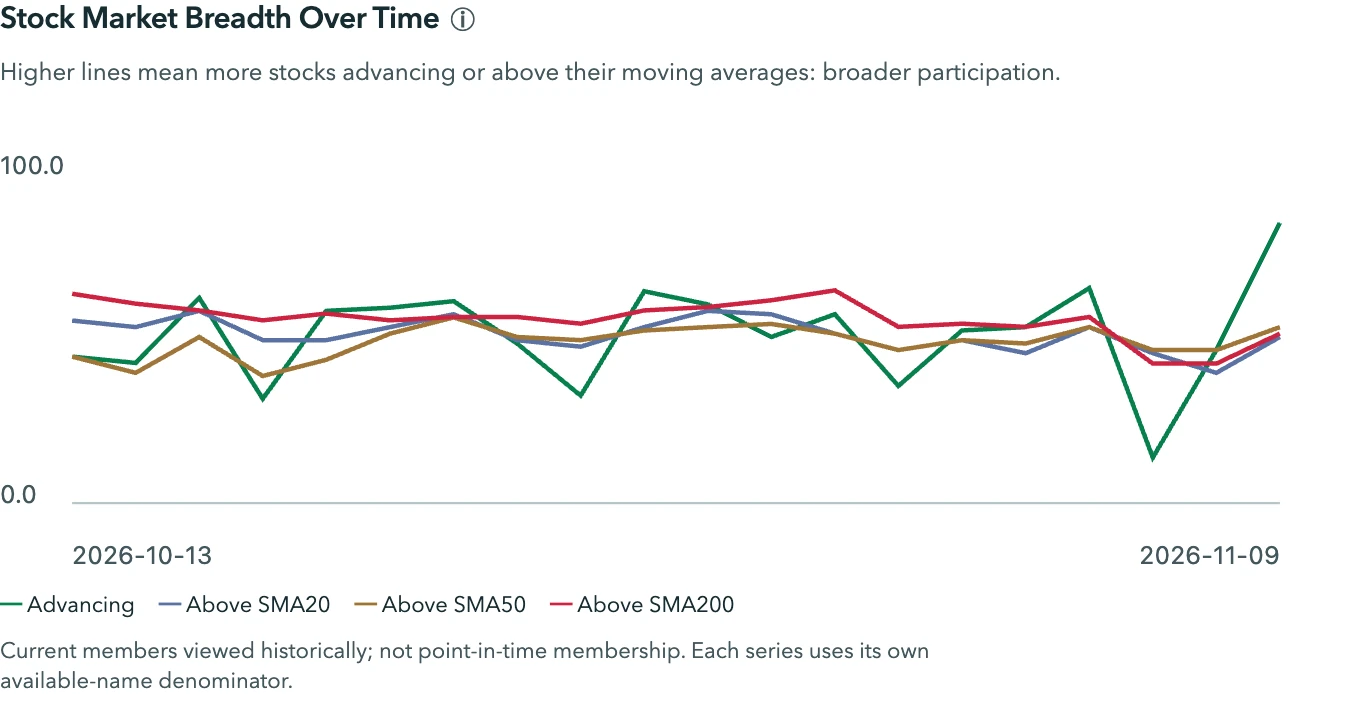
Dispersion stayed wide at 2.89 percentage points across S&P members (the 87th percentile of the past year) and 4.19 for the Nasdaq-100 (the 88th). S&P members above their 200-day went 66.5% (Nov 4), 58.4% (Nov 5), 55.8% (Nov 6), 63.0% (Nov 9); above the 50-day 61.6% to 69.4%. New highs 15 against 3 new lows (Friday 3 against 7). QQQ's shares above its 20-, 50- and 200-day rose to 50.5% / 53.5% / 51.5% from 39.6% / 46.5% / 42.4%. Friday we flagged 50% above the 200-day as the line to watch; the market moved away from it.

Leaders and laggards: chips led, NVIDIA did not
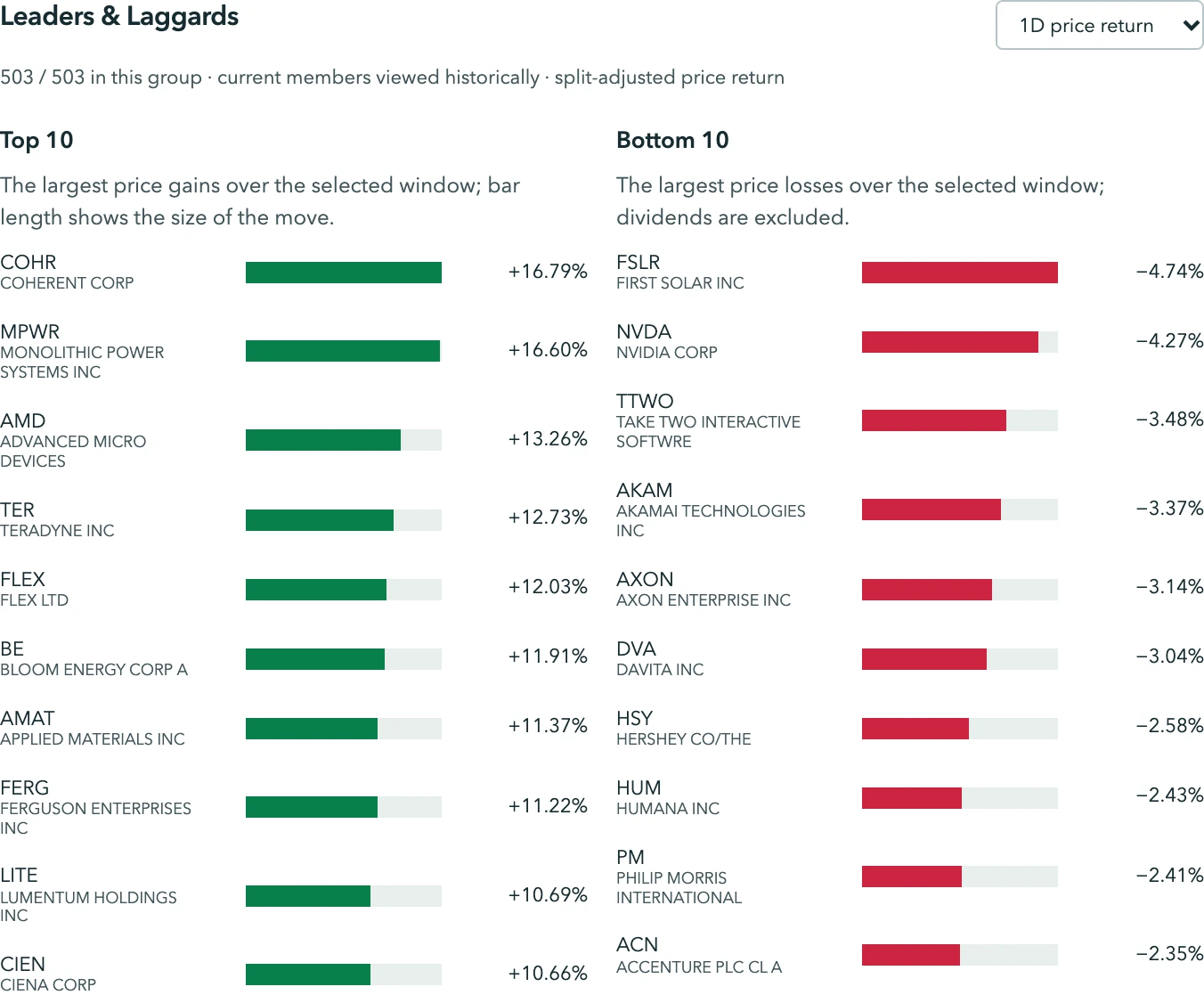
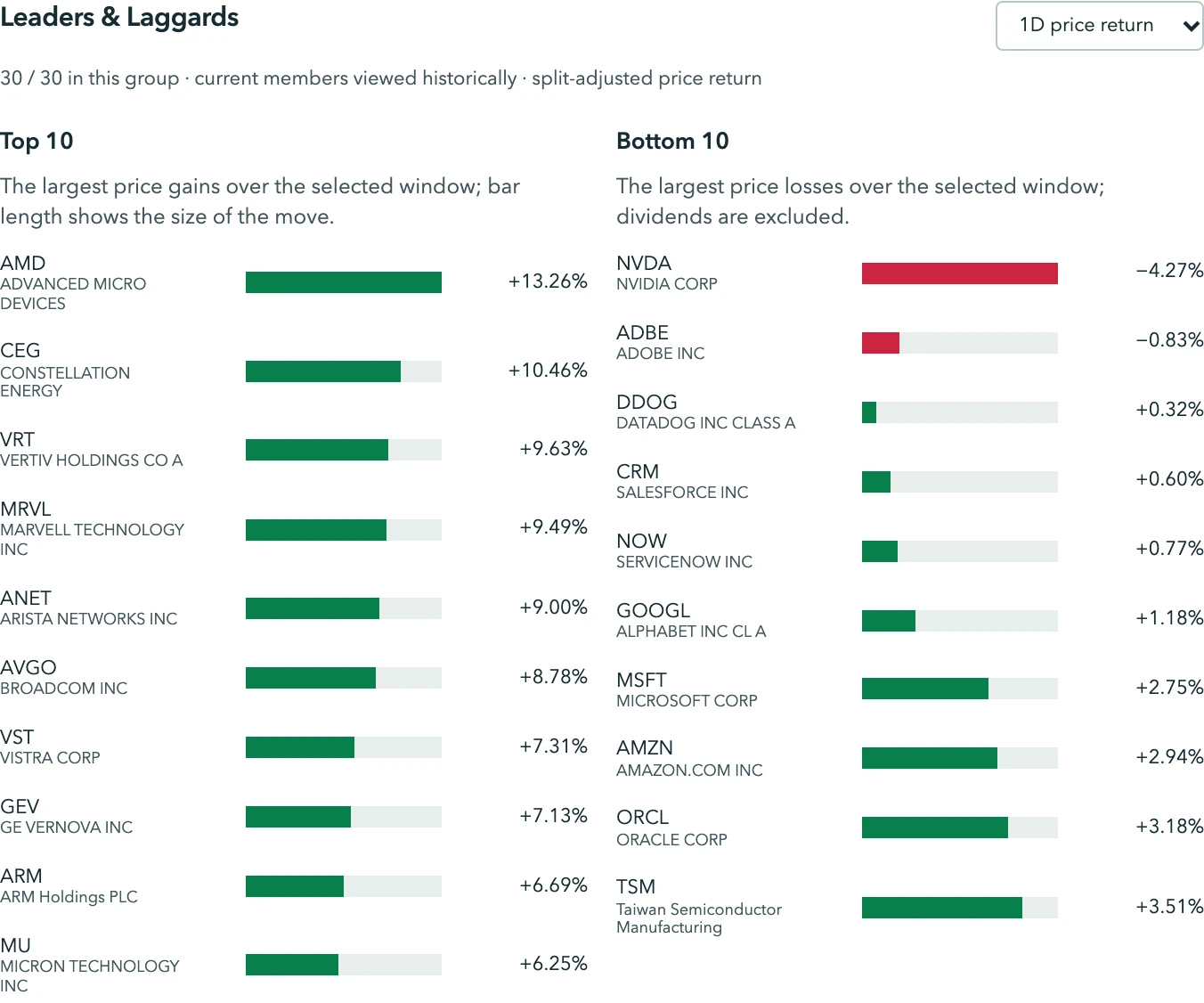
All five S&P leaders were Technology names — Coherent +16.79%, Monolithic Power +16.60%, AMD +13.26%, Teradyne +12.73%, Flex +12.03% — and the laggards were First Solar -4.74%, NVIDIA -4.27%, Take-Two -3.48%, Akamai -3.37% and Axon -3.14%. In the AI 30, Constellation Energy +10.46% (Reuters reported a third-quarter profit beat) and Vertiv +9.63% followed AMD; NVIDIA and Adobe (-0.83%) were the only decliners. NVIDIA is the single-name story: Reuters reported that its board opened an internal investigation on Sunday into whether a foreign intelligence effort targeted its chief executive (the board said it has confidence in him), that President Trump said the FBI is looking into it, and that a proposed shareholder class action was filed Monday. The espionage claims are allegations, which China called groundless; there is no finding of misconduct. Big Moves flags eight large moves with ex-dividend context unchecked; Event History is on hold.
Sectors: eleven for eleven
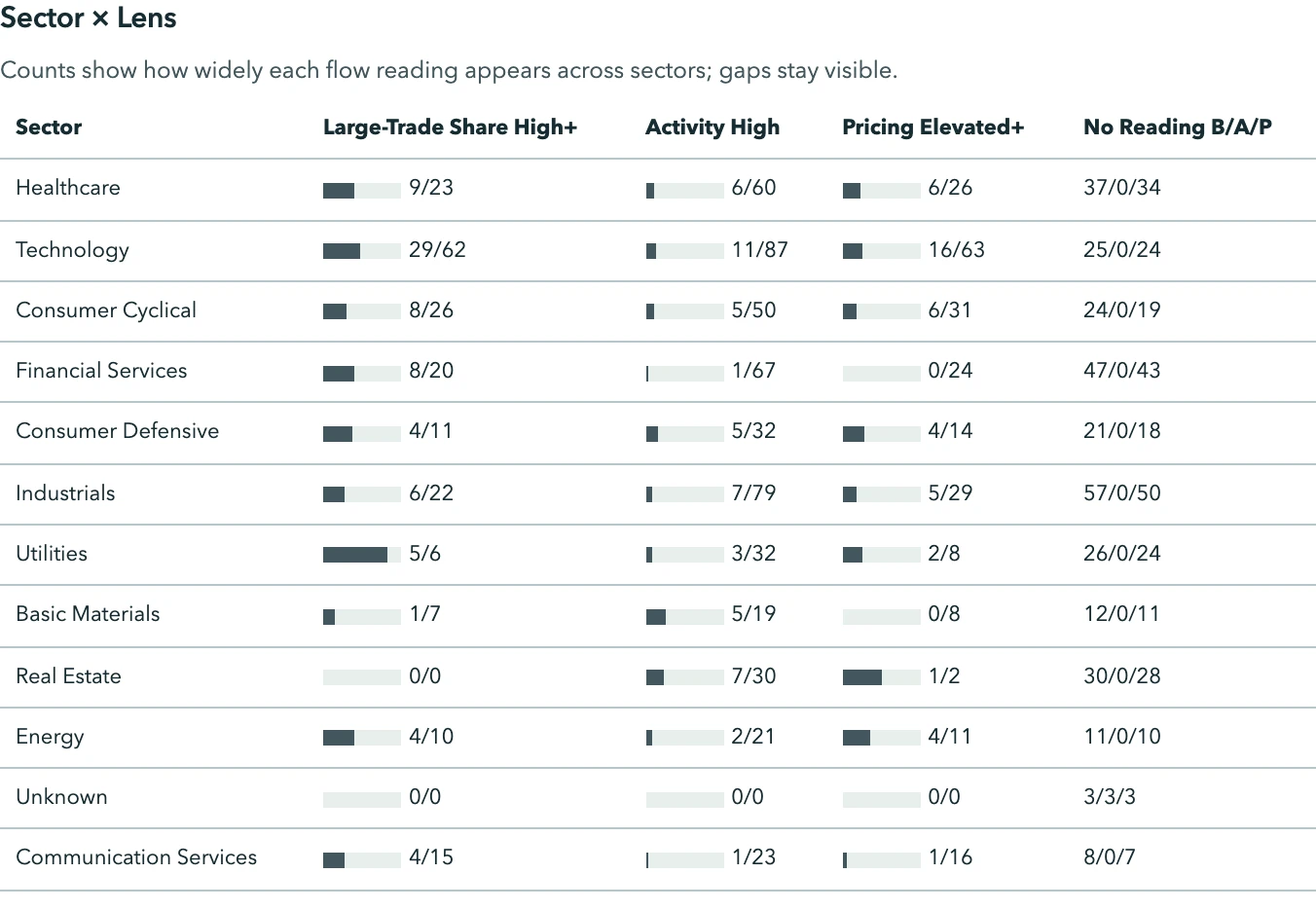
Every S&P sector had a majority advancing and a positive median. By share advancing, Real Estate 96.7%, Communication Services 95.7% and Industrials 88.6% led; Consumer Defensive 75.0% and Energy 71.4% trailed. By median gain Technology +3.66% led; Utilities (+0.88%, the smallest) and Consumer Defensive (+1.02%), two of Thursday's leaders, were among Monday's smaller gains, though Real Estate led on breadth. The Sector × Lens table shows high large-trade-share readings concentrated in Technology. Rotation is unavailable; this page's sector strip is mislabelled, so we leave it out.
Volume: a big day on ordinary volume
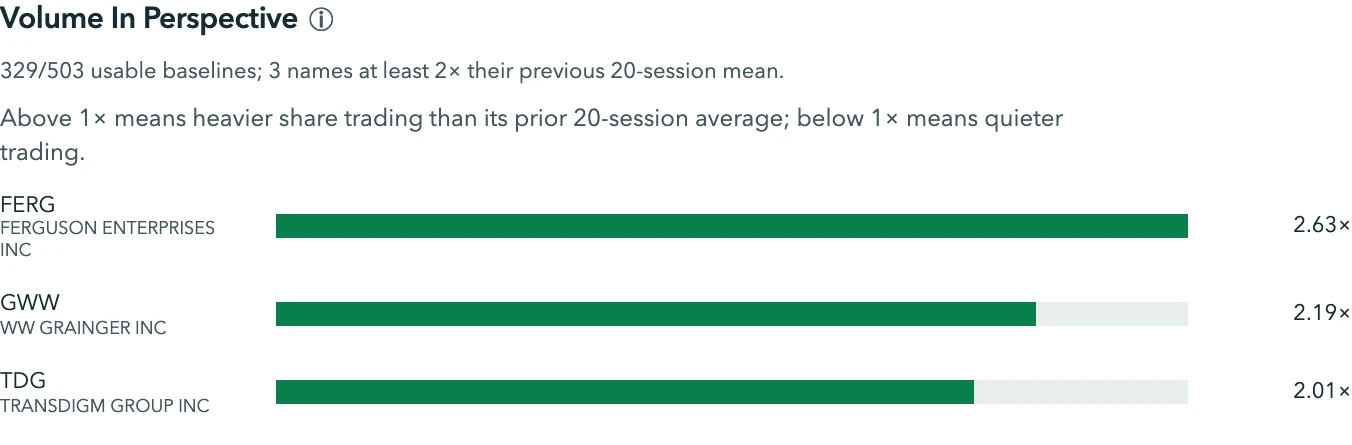
SPY's own relative volume was 1.07x and the median member's 0.94x (329 of 503 with baselines); only three names traded at twice their 20-session mean. QQQ's is unavailable; the AI 30 median is 0.90x, the crypto list 0.85x; recent volumes are provisional. In our view a 2.4% rally on ordinary member volume warrants modest rather than zero confidence in the follow-through.
Momentum: out of oversold, into the middle
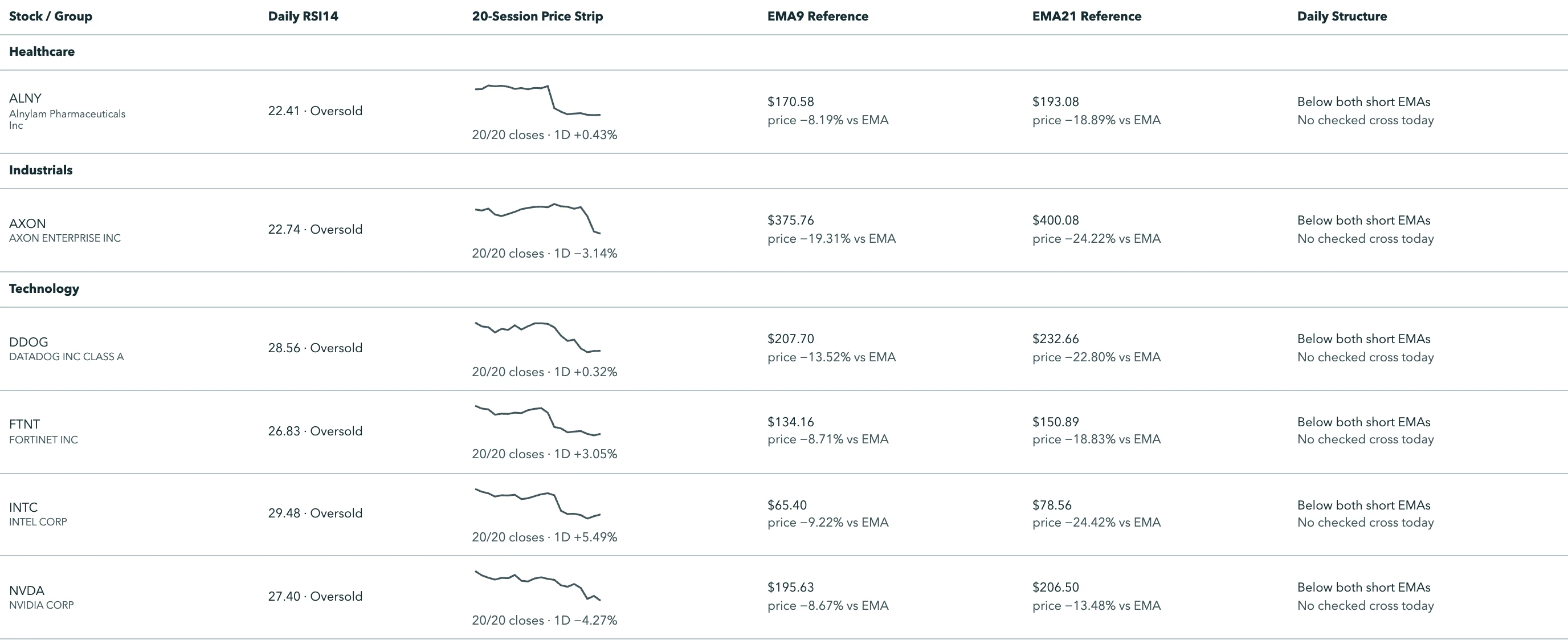
SPY's 14-day RSI rose to 45.8 from 35.1 and QQQ's to 41.4 from 31.4 — the "back into the 40s" condition we set. QQQ's oversold list is down to six names and still reads like the correction's casualty list: NVIDIA, Intel, Fortinet, Datadog, Alnylam and Axon. Marvell, oversold on Friday, rose 9.49%.
The AI Ecosystem tab
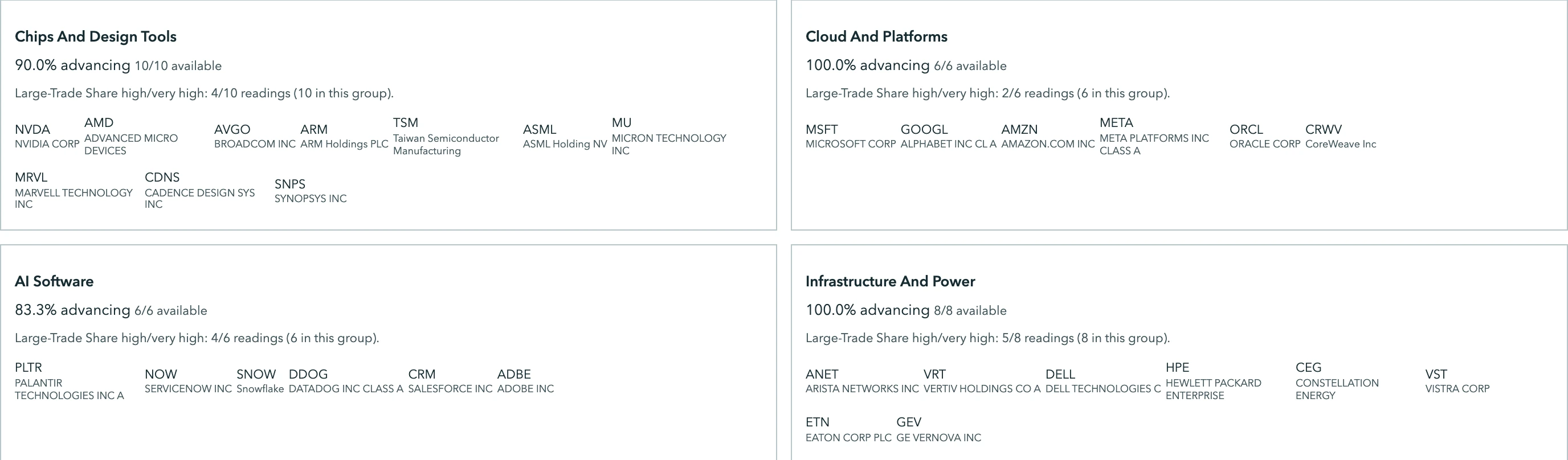
Chips And Design Tools shows 90.0% advancing (10 of 10 with readings) with 4 of 10 high-or-higher large-trade-share readings; the Cloud, AI Software and Infrastructure And Power groups all show majorities advancing.
Crypto-related equities: left out
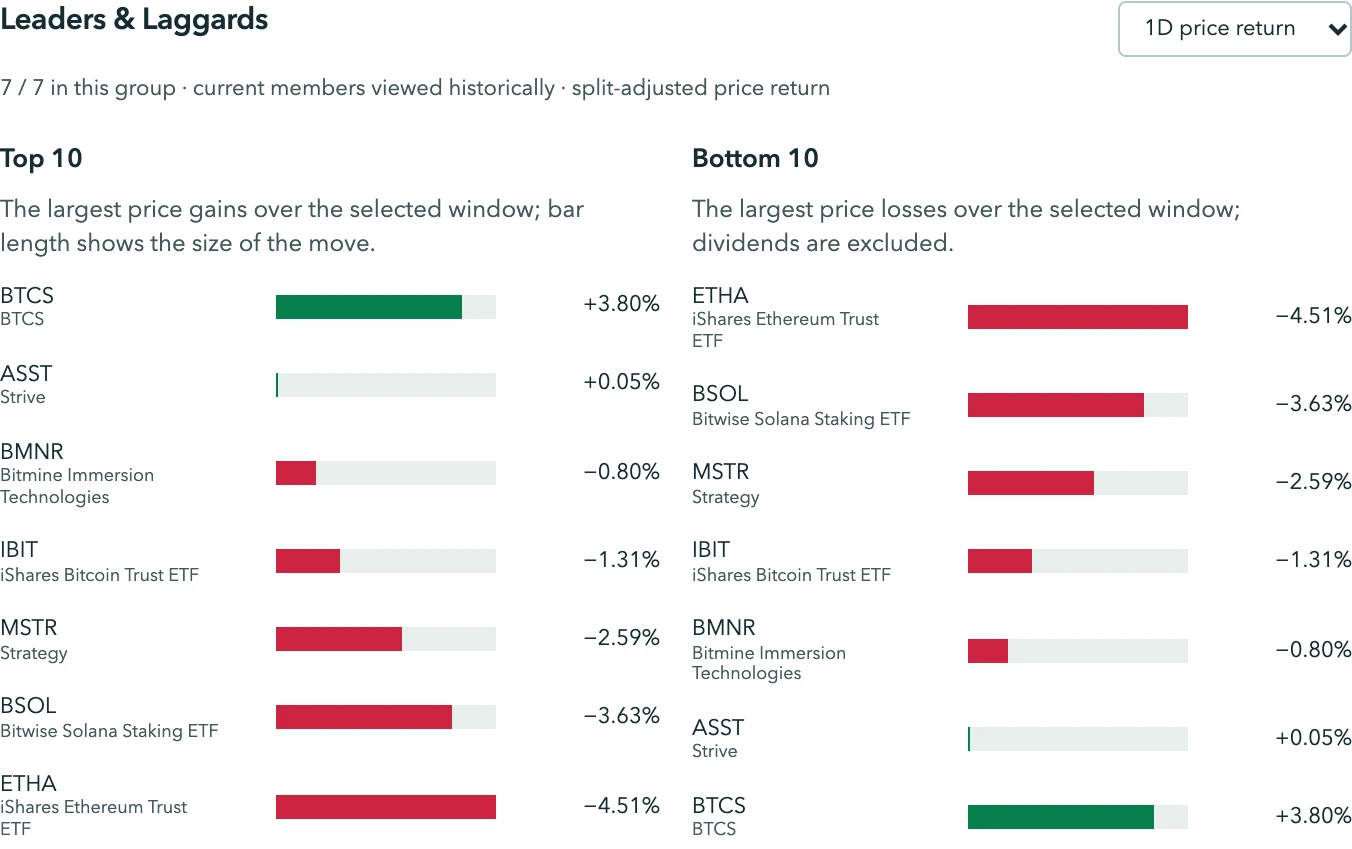
Two of seven rose (BTCS +3.80%, Strive +0.05%); the Ethereum trust fell most, 4.51%, and Strategy 2.59%. None is above its 20- or 50-day, only two are above the 200-day (four on Friday), and 20-session returns run from -9.69% to -22.56%. The risk-on day did not reach this group.
What Moved The Market Today, Fund Bridge, Flow Grid
Holding contributions are unavailable for SPY and QQQ for November 9 (no dated holdings snapshot), the AI 30 and crypto lists have no fund allocations, and the Fund Bridge and Market History concentration card are withheld, so we cannot say which holdings drove the funds. The Five Lenses grid carries large-trade-share, pricing and activity labels (18 names Extreme on options pricing) but no sentiment or position readings.
Macro panel: carried values, loud news
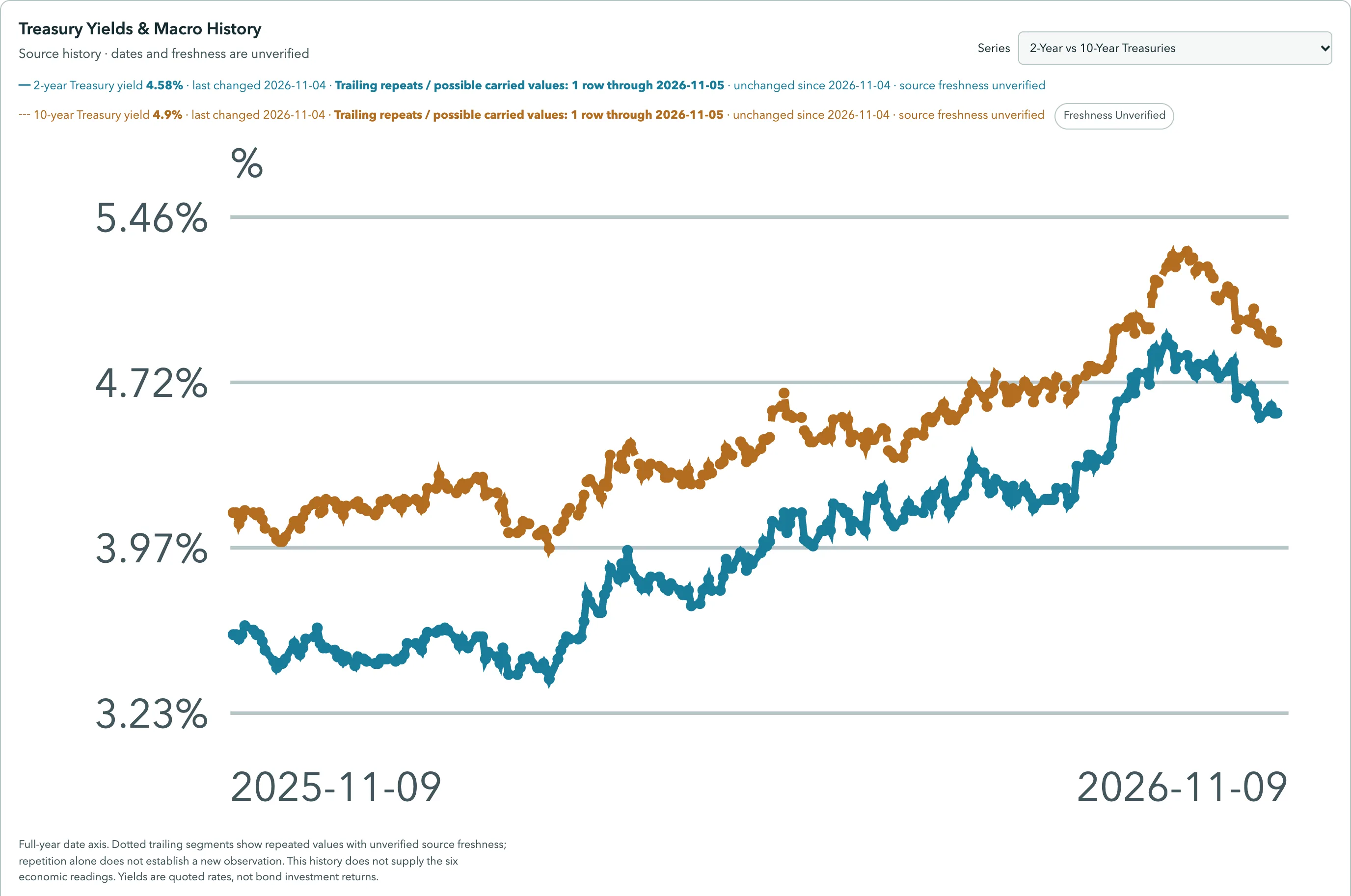
The six regime tiles read Unavailable; the yield history shows a 2-year at 4.58% and a 10-year at 4.9%, last changed November 4; the release table lists CPI (Nov 10), PPI (Nov 13), GDP and PCE (Nov 25) as not released. The Treasury's par curve for Monday: 2-year 4.56% (from 4.51%), 10-year 4.88% (from 4.86%); Reuters put December hike odds at about 84% (78% on Friday).
Market History, Performance & DCA, Stock History
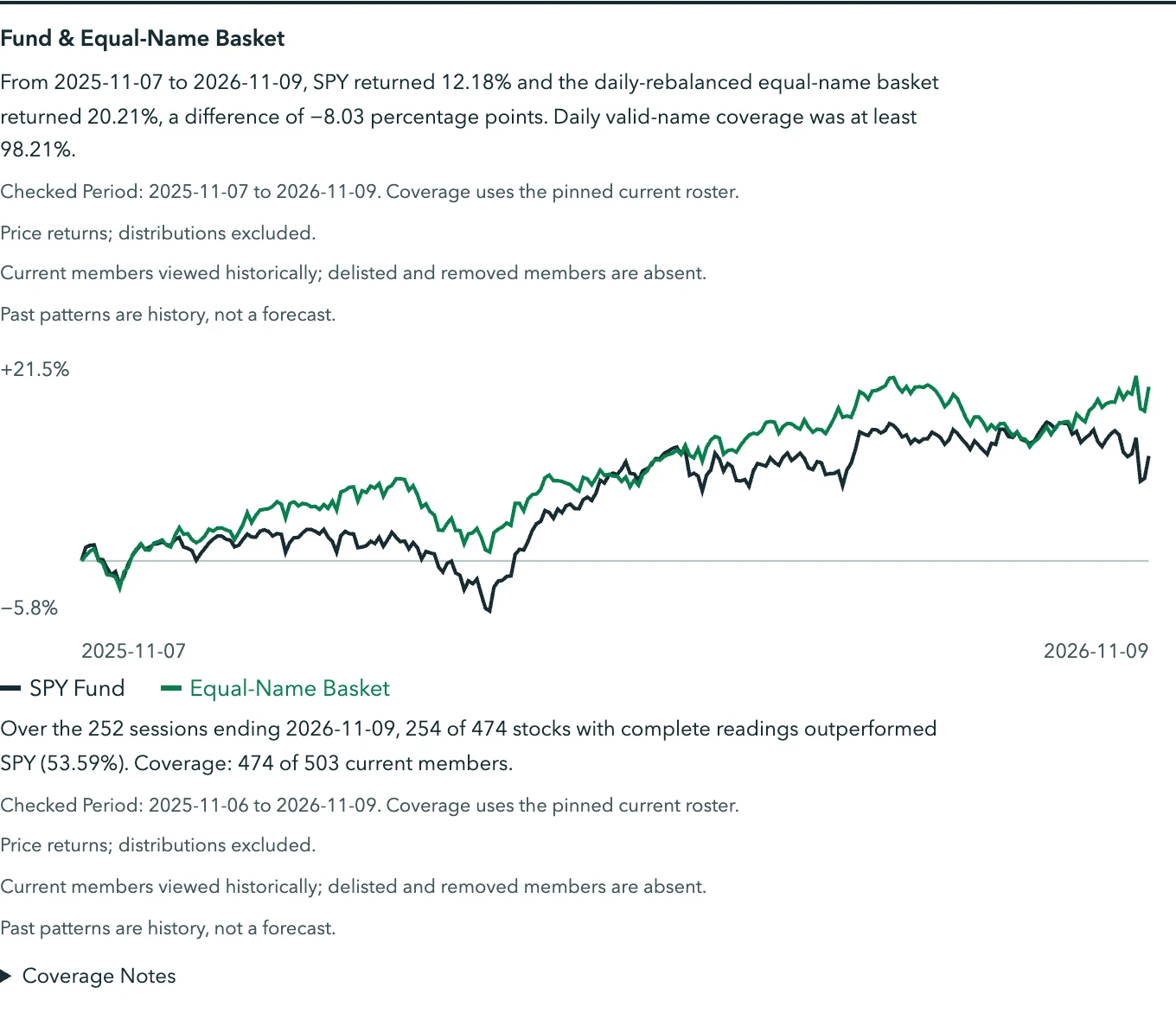
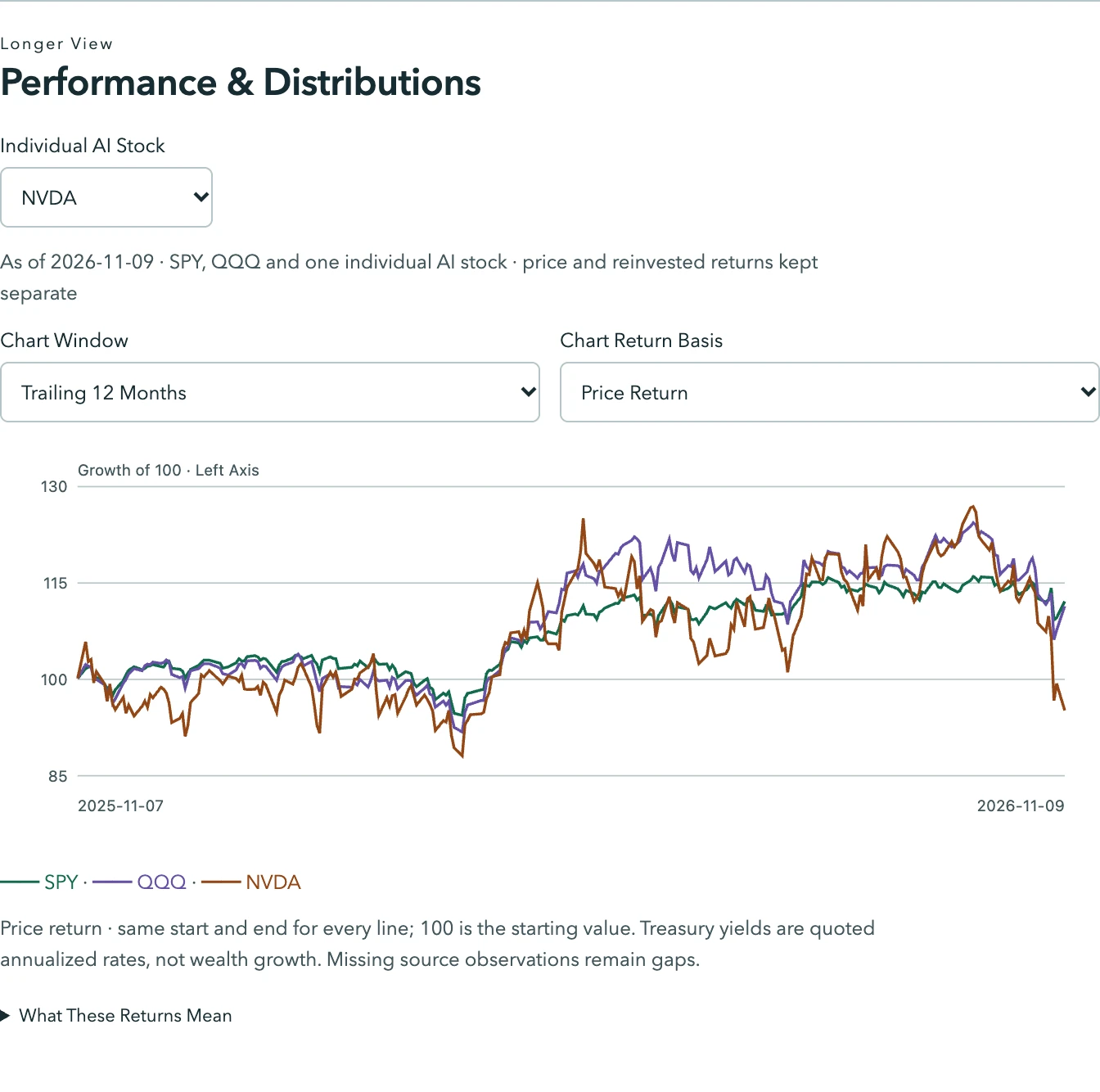
Over the twelve months to November 9, SPY returned 12.18% against 20.21% for an equal-name basket of its members, and QQQ 11.42% against 27.80%; 254 of 474 S&P stocks (53.59%) beat SPY. SPY is +10.38% for 2026 to date with a maximum drawdown within 2026 of 9.13%, and it rose at least 2% over seven sessions in 45 of 179 non-overlapping windows (25.14%): a 2% move over seven sessions is common and settles nothing. On the Performance & Distributions chart NVIDIA has given back its lead over both funds; the Recurring Investment Calculator is available (no figures quoted today); Stock History tables are populated, and its After Drawdowns card has insufficient data.
Quiet panels, in one line
The Metric Guide, The Session In One Paragraph (SPY: 423 of 503 advanced; Real Estate broadest at 96.7%), Explore This Session links, the constituent list and stock chart (NVIDIA selected at $178.67; Strategy on the crypto tab) and Share Previews are populated; the Macro summary strip, Selected Stock Context, What Happened Next, Dividends and the Lenses rail's macro-sensitivity and dividend panels are unavailable or on hold.
Economy
Readings are official releases; changes are our own computations from published levels and may differ from agency rounding. Released Friday, November 6, and already in our last entry: the October jobs report — payrolls +165k (September +60k in the current vintage), unemployment 4.1% (from 4.2%), hours 34.4 unchanged, average hourly earnings +0.37% on the month and 3.12% on the year. New since then: the Treasury's November 9 par yields; September consumer credit (+0.54%, the Fed's G.19 release) is also in the data, release time not separately verified. Still the latest, and the ones that bear on Tuesday: September CPI +0.65% (August +0.40%), core +0.33% (+0.29%), shelter +0.39% (+0.26%); September PPI final demand +1.34% (+0.47%); regular gasoline $4.153 for the week of November 2 ($4.269), with an October average of $4.31 against $4.355 in September.
Improved since the previous release: payrolls, unemployment, initial claims, job openings, pump prices, CPI food, card and consumer-loan delinquency.
Deteriorated: September headline, core, shelter, gasoline and energy CPI; all three PPI measures; real income and spending; retail sales and the control group; continuing claims.
What it means for SPY and QQQ (our view): growth is not the problem — hiring re-accelerated, claims are low, delinquencies are falling, and oil's slide eases November's energy inflation. The problem is the rate path: September's inflation data were hot, the Fed is in hiking mode, December odds are about 84%, and in a London speech early Tuesday, November 10, before the CPI release, Governor Waller said he would still support a 25-basis-point increase in December and that "…with core CPI inflation around 0.3 percent or even higher—then a stronger policy move may be needed", adding that "…a 50 basis point hike in the policy rate should be considered at the December meeting". That is the bear evidence for growth-heavy QQQ; firm labor and falling pump prices are the bull evidence for the broad S&P. In our view, a consumer whose real income fell in September is the risk to watch behind both.
Next release that could change this: October CPI, Tuesday, November 10, 08:30 ET; this is written before the print. The Reuters poll expects headline +0.3% and core +0.2% on the month, against September's +0.6% and +0.3%. Gasoline, up 9.1% in September's index and down at the pump through October, should swing to a small or negative contribution; shelter, 0.39% in September, is the main route to a 0.2% core if it returns toward 0.2–0.3%. The statistics agency published no October 2025 CPI because of last year's shutdown, so an official 12-month change may be absent. Then PPI Friday, November 13; retail sales Tuesday, November 17; the jobs report Friday, December 4.
Outlook
Scenarios with conditions, not predictions; the weights are our subjective leanings. All three are defined over the four sessions from Tuesday, November 10 through Friday, November 13, so exactly one will have happened; the levels come from Monday's data.
Bear — "the gap closes" (about 25%). SPY closes below Monday's opening price of $741.95 on any day, or QQQ closes below its opening price of $662.64. We would expect it to arrive with core CPI at 0.3% or higher, a higher 2-year yield and fewer than 60% of S&P members advancing on the breakdown day.
Bull — "the averages are reclaimed" (about 30%). Neither bear trigger fires; SPY closes Friday, November 13 above its 20-day average of $762.09 and QQQ above its 200-day average of $681.17. That would open the path toward the November 4 closes ($766.81 for SPY, $691.95 for QQQ).
Base — "hold, don't extend" (about 45%). Everything else: the gap holds but one or both averages are not reclaimed by Friday; CPI is absorbed without a trend decision and the market waits for NVIDIA on the 17th.
Before turning constructive on concentrated AI we would want: the AI 30 share above its 50-day rising from 16.67% toward a third; a QQQ close above its 200-day that holds more than one session; NVIDIA holding Monday's $178.67 close into its November 17 report; and CPI passing without a jump in hike odds.
Warning signs that would strengthen the case for caution: a SPY close below $741.95; a QQQ close below $662.64; core CPI at 0.3% or higher with the 2-year yield rising from 4.56%; the share of S&P members above the 200-day back under 55%; new lows exceeding new highs (Monday: 15 highs, 3 lows); QQQ's options-pricing label back at Extreme on a down day.
Dip, wait, or trim? In our view the broad market has so far behaved like a pullback inside an uptrend rather than a breakdown: SPY is 3.39% from its high, 63.0% of its members are above their 200-day, and the broad up day we required has happened — the day before the month's most important release, so it is on probation until CPI is absorbed. Concentrated AI and semiconductor exposure had a sharp bounce (AI 30 median +5.46%) but not a repair: one name in six above its 50-day, the average name 30.80% below its 52-week high, the group's largest stock diverging lower. Dip-buyers would want the signposts above before treating that bounce as a low, and a case for trimming would build on either bear trigger. Net: constructive-leaning on broad exposure, wait-and-see on concentrated AI, with Monday's opening prices as the lines that would change our reading.
Key dates (times ET; dates can change; † = unverified): Tue Nov 10, 08:30 — October CPI. Wed Nov 11 — Veterans Day: stocks open, bond market close recommended (SIFMA), no labor-statistics releases. Thu Nov 12 — jobless claims†. Fri Nov 13, 08:30 — October PPI. Tue Nov 17 — retail sales 08:30; NVIDIA after the close. Wed Nov 18, 14:00 — FOMC minutes. Wed Nov 25† — Q3 GDP second estimate and October PCE. Fri Dec 4† — November jobs report.
Final summary
- CPI at 08:30 ET Tuesday. In our view a 0.2% core keeps the rebound intact; 0.3% or higher, with Governor Waller having put a 50-basis-point December hike on the table in that case, is the scenario that could fill Monday's gap.
- Monday's opening prices: $741.95 for SPY, $662.64 for QQQ. Closes below them would, in our view, mean the confirmation failed; Friday closes above $762.09 (SPY's 20-day) and $681.17 (QQQ's 200-day) would mean it extended.
- The AI repair count. Five of 30 AI names above their 50-day is a bounce; a rising count into NVIDIA's November 17 report would make it a trend.